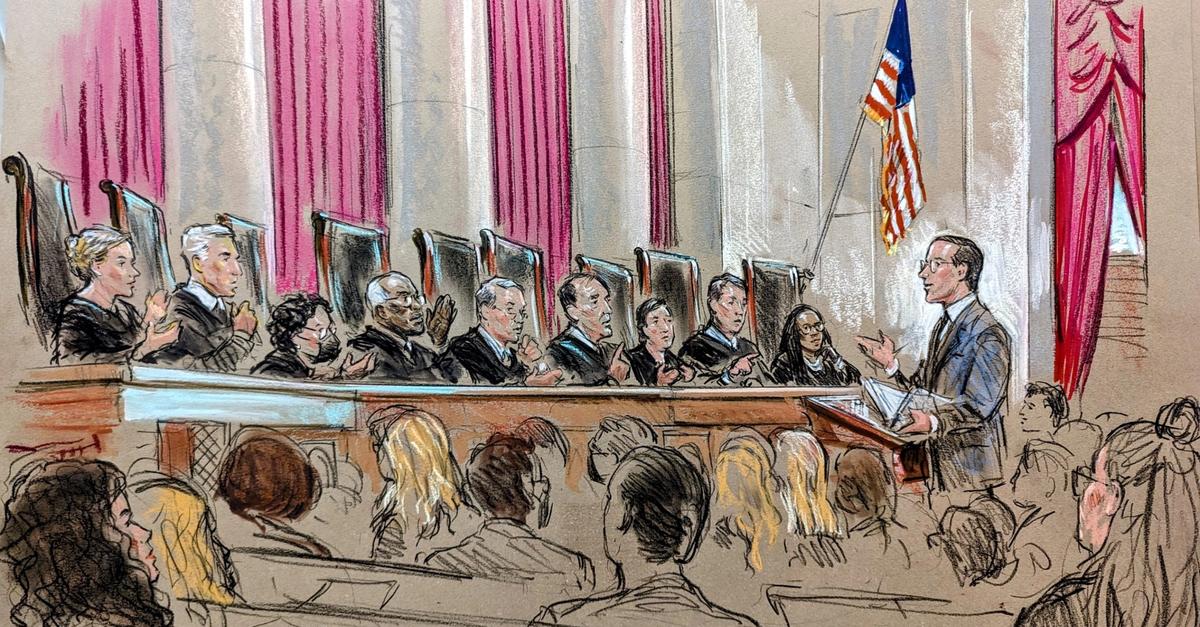
The clang of gavels. That’s what most of us associate with the Supreme Court, a sound signaling finality. But a deeper dive into the transcripts reveals a far more nuanced reality, particularly when the justices themselves are divided.
Adam Feldman’s “Empirical SCOTUS” series, a recurring deep dive into the data behind judicial decision-making, is back with a compelling look at oral arguments. This isn’t about legal philosophy; it’s about raw behavior, meticulously tracked. The core question: does the way justices question advocates during oral arguments foreshadow whether a case will end in a unanimous 9-0 decision or a fractured 5-4 split?
The answer, presented with cold, hard numbers, is a resounding yes. And the differences are stark.
The Battlefield: Six Cases Examined
Feldman’s analysis zeroes in on six cases from the October 2023 Term. Three were settled unanimously (9-0): Barrett v. United States, Berk v. Choy, and Ellingburg v. United States. The other three were contentious, resulting in splits of 5-4, 5-4, and 6-3: United States Postal Service v. Konan, Bowe v. United States, and Hencely v. Fluor Corp.. The doctrinal range is broad – statutory interpretation, habeas corpus, military liability, sentencing, civil procedure, and restitution – lending significant weight to the observed patterns.
Volume: Contested Cases Dominate the Airwaves
It’s almost intuitive, but the data confirms it: divided cases simply generate more noise. Contested arguments averaged a hefty 93.7 transcript pages, a stark contrast to the 73 pages for unanimous decisions. More telling, perhaps, is the number of times justices actually spoke: an average of 200.3 turns asking questions in contested cases versus 136.7 in unanimous ones. Even the transitions between justices — moments where the conversational baton is passed — spiked to 60.3 in divided cases compared to a comparatively quiet 36 in unanimous ones.
This isn’t just about volume. It underscores a fundamental difference in purpose. In unanimous cases, oral argument often serves to clarify existing understanding or confirm consensus. In contested cases, however, it becomes a real-time negotiation, a public working-through of disagreements, not just between the advocates and the bench, but crucially, amongst the justices themselves. They’re pressing harder, revisiting thorny issues, and implicitly — or explicitly — signaling their own positions and challenging those of their colleagues.
The Tone of the Inquiry: Skepticism Rules the Day
Beyond sheer volume, the nature of the questioning itself shifts dramatically. Feldman identifies “skeptical and challenging turns” – those that directly confront an advocate’s argument or expose its weak points. These averaged a significant 35.0 per contested argument, compared to just 24.0 in unanimous settings. Similarly, questions that probe the “underlying logical foundations” averaged 26.3 in contested cases, against 18.7 in unanimous ones.
This isn’t just justices playing devil’s advocate. This data suggests that when multiple justices relentlessly grill an advocate on the bedrock of their position, it’s a genuine reflection of the court’s own internal fissures. The bench isn’t just exploring; they’re grappling with fundamental disagreements. Conversely, a quieter, more clarification-focused inquiry often signals that consensus is not only likely but already established.
Justice-Level Dynamics: Who’s Leading the Charge (and Who’s Not)
Zooming in on individual justices adds another layer of clarity. Feldman notes that the justice who will eventually author the majority opinion doesn’t necessarily dominate the questioning. Instead, dissenters often lead the charge, asking more questions and, predictably, voicing more skepticism towards the eventual winning side. A prime example is Justice Ketanji Brown Jackson in Konan, who had the highest turn count among all justices, aligning with her eventual dissent.
And then there’s the perennial outlier: Justice Clarence Thomas. His pattern, as widely observed, is distinct. In this sample, Thomas consistently asked the fewest or near-fewest questions, and his style leaned heavily toward exploratory and doctrinal, suggesting a focus on information gathering rather than forceful advocacy for a particular outcome. It’s a consistent thread in his judicial approach, seemingly unswayed by the court’s impending divisions.
What this analysis truly underscores is that the Supreme Court isn’t a monolith, and its internal deliberations — even the public-facing ones — offer tangible clues about its direction. The days of treating oral argument as mere judicial theater are long past; the data now clearly shows it’s a critical indicator of the court’s internal currents.
When multiple justices are pressing an advocate hard on the foundations of their argument, it often reflects that the court itself is genuinely divided about those foundations.
This is a data point that institutional investors, legal strategists, and even academics tracking legal trends can’t afford to ignore. The court’s discourse is its decision-making process unfolding in real time, and Feldman’s work has effectively decoded a significant part of its language.
Will Skepticism at Oral Argument Predict Supreme Court Decisions?
While the study doesn’t claim oral argument determines the outcome, the data strongly suggests a correlation. Higher volumes of questions, particularly those characterized by skepticism and deep probing of foundational logic, consistently appear in cases that later divide the court. This isn’t a perfect crystal ball, but it’s a remarkably consistent indicator. The justices aren’t just asking questions; they’re signaling their doubts and their divisions.
What Does This Mean for Legal Strategy?
For litigators preparing for oral arguments, this analysis offers strategic imperatives. Understanding the potential for dissent based on preliminary questioning can inform how advocates frame their responses. If the bench is divided, a more strong defense of fundamental principles might be necessary, as opposed to a purely clarification-based approach. Furthermore, anticipating which justices are likely to be the most critical can help in tailoring arguments to address their specific concerns. It’s about reading the room, or in this case, the bench, with data-backed precision.
🧬 Related Insights
- Read more: Patent Examiner Reddit Furor Sparks Congressional Inquiry
- Read more: SCOTUS Patent Cases: What’s Still Hanging?
Frequently Asked Questions
What is Empirical SCOTUS? Empirical SCOTUS is a series by Adam Feldman that uses data analysis, primarily from Supreme Court opinions and oral arguments, to offer insights into the justices’ decision-making and predict future court trends.
Does oral argument always predict the outcome of a Supreme Court case? No, oral argument doesn’t always predict the outcome. However, this analysis shows that the nature and volume of questioning during oral arguments are highly correlated with whether a case will be decided unanimously or by a divided vote, offering a strong indicator of potential disagreement.
How does Justice Thomas’s questioning differ? Justice Thomas is noted for asking fewer questions than other justices, and his questioning style tends to be more exploratory and doctrinal, focused on gathering information rather than pressing a specific argument or challenging existing premises.