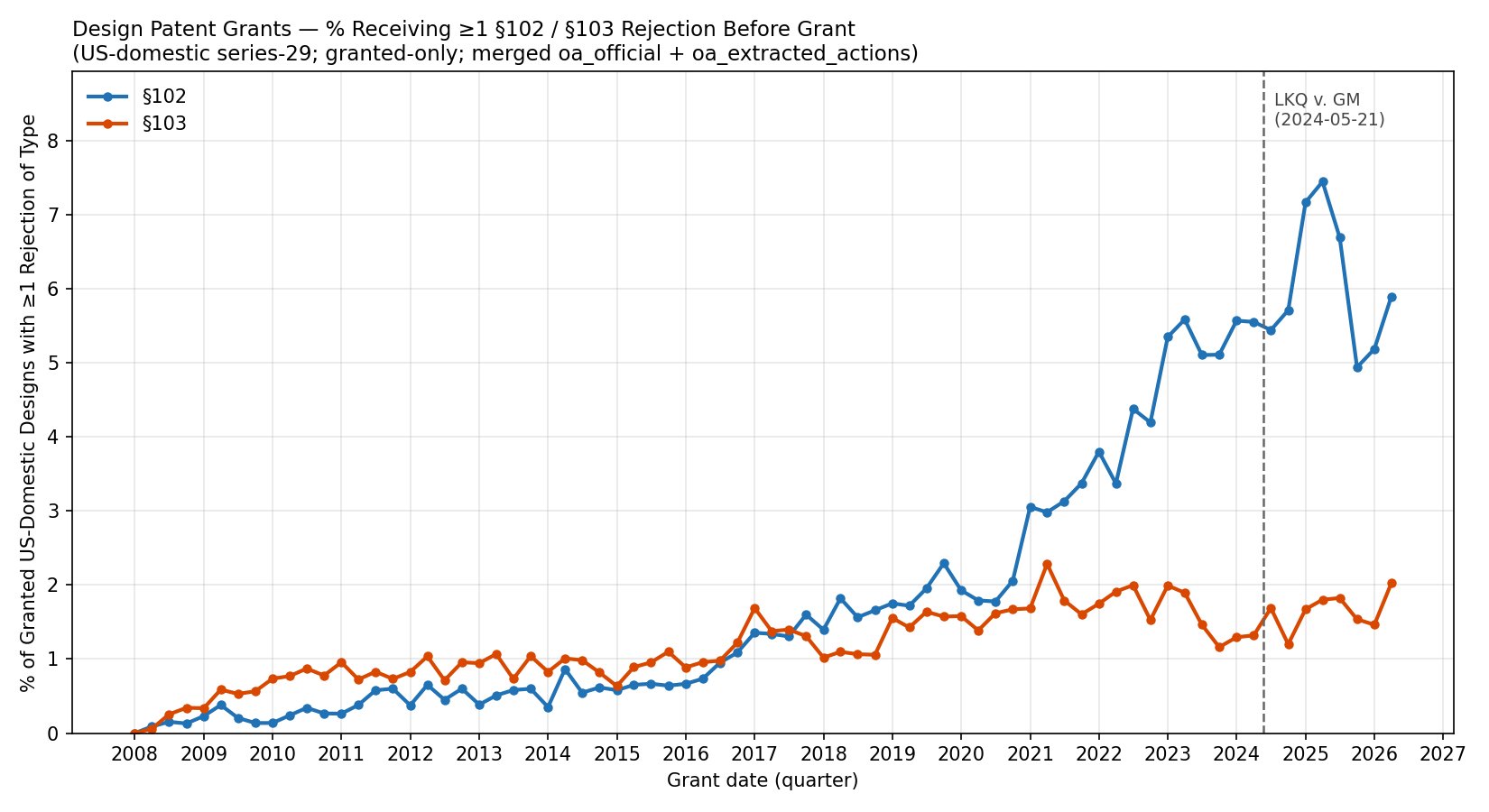
The numbers don’t lie. Roughly 0.1% of U.S.-domestic design patents issued in 2008 faced a prior art rejection under §102. Fast forward to early 2025, and that figure had ballooned to over 7%. Even after a slight pullback under Director Squires to around 5-6%, we’re talking about the highest sustained level of these rejections ever recorded.
For many practitioners, this represents a complete overhaul of the examination landscape. Gone are the days when prior art hurdles were a mere formality. Now, it’s a full-blown battleground, demanding a far more aggressive and anticipatory approach to filings.
The Marketplace Effect
The most compelling hypothesis for this surge points squarely at e-commerce giants. Specifically, searches conducted on platforms like Amazon.com are surfacing products that are already firmly embedded in the U.S. consumer market.
This isn’t about abstract prior art existing in some dusty patent archive. No, this is about tangible, readily available goods that examiners can, and evidently are, finding. Domestic applicants, whose products are likely to appear on these platforms concurrently with or even before their patent filings, are finding themselves disproportionately affected.
Conversely, Hague System applicants—who are predominantly foreign—may not have their goods widely distributed in the U.S. market at the examination stage. Their products might also be listed on less thoroughly searched platforms like Alibaba. The net effect? U.S.-originated applications appear to be undergoing a far more rigorous examination process than their international counterparts.
Most of the rise in anticipation rejections has come from searches of US-facing marketplace platforms - Amazon.com in particular.
This is a critical distinction. It suggests that the very nature of how we bring products to market is now directly influencing their patentability. The ‘prior art’ isn’t just what was patented before; it’s what’s for sale now, conveniently aggregated on a platform that patent examiners are clearly leveraging.
Is Amazon the New Prior Art Standard?
It’s a provocative question, but the data leans toward ‘yes.’ The surge in §102 rejections isn’t a uniform global phenomenon across all design patent filings. It’s concentrated in domestic cases. And the leading explanation is the increased accessibility of U.S. market products via online marketplaces.
This creates a fascinating, and potentially unfair, asymmetry. A domestic inventor might see their own product already for sale on Amazon before they’ve even filed their patent application, leading to an anticipation rejection. Meanwhile, a foreign competitor might have a similar product but only sell it in their home market or through channels not actively searched by the USPTO, thus avoiding the same scrutiny.
Think about it: patent law, at its core, is about enabling innovation by granting exclusive rights. But if the definition of ‘prior art’ morphs to include readily available commercial goods that are easily discoverable, does that inadvertently stifle domestic innovation by making it harder to secure patents on new designs that are immediately visible in the marketplace?
This trend also has significant implications for companies that rely heavily on design patents for market exclusivity. The window for securing that protection might be shrinking, and the examination process is certainly becoming more complex and data-intensive. It suggests a need for a more proactive, almost real-time, understanding of market availability for any new design. It’s not enough to just look at old patents; you have to look at what’s actively being sold today.
Why Does This Matter for Legal Tech?
For legal tech companies, this shift represents a clear opportunity—and a clear challenge. Tools that can proactively scan online marketplaces for potential prior art, beyond traditional patent databases, are becoming indispensable. The ability to predict and mitigate these §102 rejections is moving from a ‘nice-to-have’ to a ‘must-have.’
Consider the economics. The cost of a design patent rejection, and the subsequent prosecution to overcome it, can be substantial. If a company can identify potential prior art issues before filing, it saves time, money, and preserves the integrity of their intellectual property strategy.
This also forces a re-evaluation of what constitutes ‘prior art’ in the eyes of the USPTO. If examiners are increasingly relying on marketplace searches, then legal professionals need tools that mirror this behavior. The future of patent prosecution, at least for designs, seems intrinsically linked to the digital marketplace.