Design patent obviousness? Unchanged.
The ink barely dried on the Federal Circuit’s en banc LKQ Corp. v. GM Global Technology Operations LLC decision two years ago, and while the legal boilerplate has undoubtedly been updated, the actual impact on design patent rejection rates appears to be, well, negligible. It’s a market dynamic that should make anyone paying attention to intellectual property law pause.
Consider the numbers: a paltry 1% of design applications face an obviousness rejection, a figure that has remained remarkably consistent and flatlining for years. This stubbornly low rate stands in stark contrast to what one might expect after a ruling aimed at enabling a more rigorous examination process. It begs the question: was the hype justified, or are we simply seeing a superficial language shift by examiners?
Shifting Language, Static Outcomes
Examiners are indeed adapting. They’ve shed the old Rosen framework and its associated phrases like “so related,” which are now conspicuously absent from rejection texts. Data shows a dramatic swing from 80% of pre-LKQ rejections citing Rosen to a near 0% post-LKQ. This is replaced by a new lexicon: “visually similar” (0% to 90%) and “overall appearance” (40% to 75%) now dominate. Intriguingly, the LKQ decision itself is cited in a mere 4% of post-LKQ rejections, and KSR is at a flat 0%. Almost 90% of these post-LKQ §103 rejections offer no obviousness precedent whatsoever.
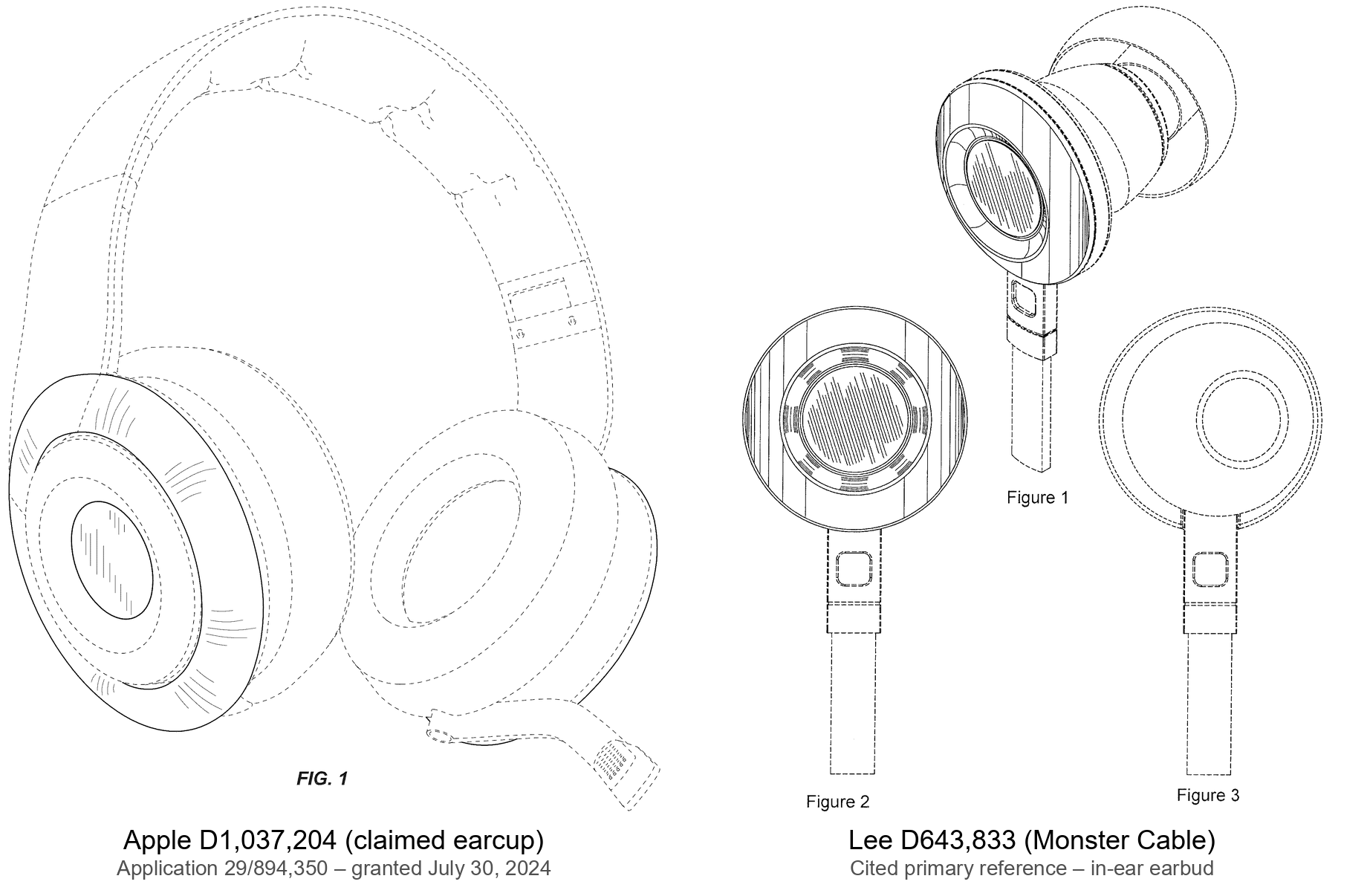
But does this linguistic gymnastics translate to teeth? A detailed review of several rejections suggests some examiners are indeed probing deeper, pushing the boundaries with prior art combinations that likely wouldn’t have flown under the older, more restrictive Rosen standard. Examples include Aristocrat’s slot-machine GUI rejected over a structurally dissimilar primary, and TOPPAN’s curved-glass panel combined with utility patents and web URLs. Yet, the most aggressive single-reference rejection observed in the dataset—Apple’s over-ear headphones against a Monster Cable in-ear earbud—actually predates LKQ, falling under the old Rosen-Durling framework.
This suggests a fundamental disconnect. While the legal framework for obviousness analysis in design patents has been theoretically strengthened, the practical application by patent examiners seems to be lagging considerably. It’s a classic case of institutional inertia, where updating the rulebook doesn’t automatically recalibrate behavior on the ground, especially when resources—like examiner time for thorough prior art searches—might be constrained.
Why Does the LKQ Outcome Matter for Innovation?
The implications here are substantial. For inventors and companies investing in design innovation, the promise of a more strong examination process, intended to prevent the patenting of obvious designs, appears to be unfulfilled. If the LKQ decision isn’t translating into more meaningful rejections, it could mean that the USPTO is still granting patents for designs that perhaps shouldn’t be patentable, potentially stifling downstream innovation by creating unnecessary patent thickets or limiting legitimate design freedom.
Think about it: if the high bar set by LKQ is only being nudged, not cleared, then the market is still awash with potentially questionable design patents. This creates uncertainty for competitors and can lead to costly litigation when perfectly legitimate design choices are challenged by patents that perhaps never should have been granted in the first place. It’s a drag on competition and a barrier to new market entrants.
And this isn’t just about obscure design patents; it impacts product development cycles across industries—automobiles, consumer electronics, furniture, you name it. The clarity and strength of design patent protection directly influence investment decisions. If that protection is weaker in practice than in principle, it subtly but surely warps R&D priorities.
Is the USPTO Under-Resourced for LKQ?
One can’t help but wonder if the issue isn’t just examiner adaptation but fundamental resourcing. A truly rigorous obviousness analysis, especially for complex designs, requires significant time for deep prior art searches and thoughtful comparison. If examiners are pressed for time—and historical trends suggest this is often the case—they may be relying on superficial keyword searches and standard phrasing rather than engaging in the kind of in-depth analysis that LKQ seemingly demands. It’s like asking a chef to prepare a Michelin-star meal with only five minutes and a microwave. The intent might be there, but the execution is hobbled by practical limitations.
This isn’t to excuse the examiners, but to highlight a systemic challenge. The USPTO needs to ensure its examiners are not only trained on the nuances of LKQ but also given the time and tools to apply them effectively. Without this, the legal victory in LKQ risks becoming an academic footnote rather than a transformative moment for design patent law.
What we’re seeing isn’t necessarily a failure of the law, but perhaps a failure of its implementation—a familiar story in patent land. The legal framework has changed, but the practical reality of examination hasn’t caught up. Until that gap closes, the market dynamics of design patents will remain much as they were, pre-LKQ.