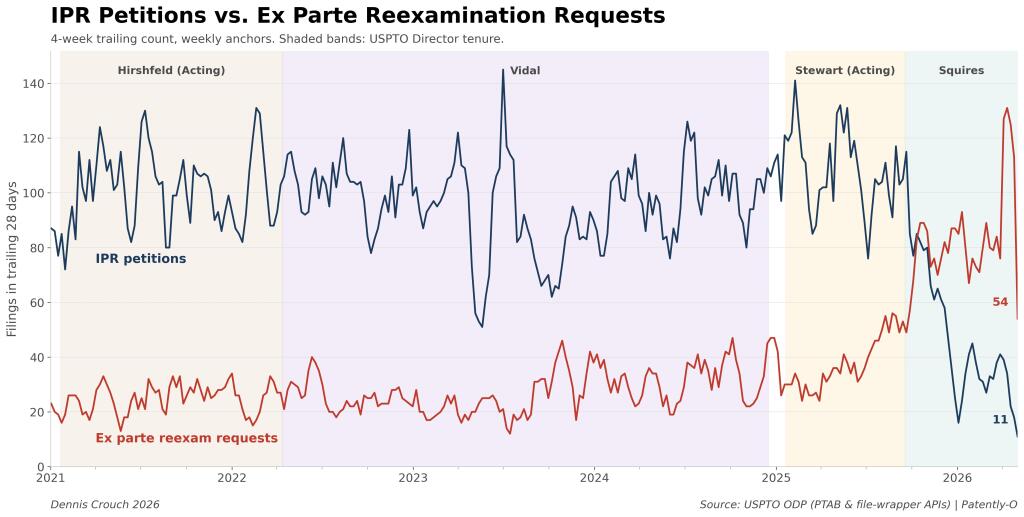
The U.S. Patent and Trademark Office (USPTO) just dropped a ruling that’s going to make patent challengers rethink their playbooks. This Decision on Remand, handed down Monday, April 27, 2026, isn’t just some bureaucratic clarification; it’s a sharp pivot on when estoppel under 35 U.S.C. § 315(e)(1) truly attaches. Specifically, it redefines what it means to “request” a proceeding “before the Office,” and the implications for timing and strategy are considerable.
We’re talking about the increasingly common dance where a party initiates an inter partes review (IPR) and then simultaneously—or near-simultaneously—files for ex parte reexamination on the same patent. The crux of the issue in the HID case was whether filing a reexamination request while an IPR was still underway, but before that IPR reached a final written decision, would shield the petitioner from estoppel. The answer, now, is a resounding no, if the final decision lands before the reexamination is formally ordered.
What Does “Request” Even Mean Anymore?
The core of the USPTO’s reinterpretation centers on the word “request” as it appears in Section 315(e)(1). This section, as you know, bars a petitioner (or those aligned with them) from pursuing or maintaining a proceeding before the Office on claims already covered by a prior IPR’s final written decision, provided the grounds could have been raised in that IPR.
The Office has now drawn a clear line in the sand, splitting the timeline into two distinct phases:
- The pre-order window: This period begins the moment an ex parte reexamination request is filed and ends just before the Director issues an order for reexamination under Section 304. During this phase, the Office is merely considering the request; no formal proceeding has commenced.
- The post-order window: This is the period after the Section 304 order is issued. Here, a true proceeding is underway.
This distinction is critical. Prior to the Section 304 order, there isn’t even a “proceeding” to “maintain.” This aligns with the Office’s prior stance that it could continue an already ordered reexamination even if an IPR issued later. But it directly challenges the notion that the pre-order phase itself constitutes a “proceeding” that could be maintained.
“Petitioners can no longer bank on filing a reexamination request during pendency of an IPR…and securing an order before a final written decision issues.”
The expanded definition of “request” now captures the entire act of seeking reexamination, from the initial filing all the way through the statutory window for the Director’s decision (which is capped at three months under Section 303). This means Section 315(e)(1) estoppel can indeed apply if a final written decision from an IPR arrives during this “request” period. That’s precisely what tripped up HID. Their IPR final written decision landed on August 13, 2024. Four days prior, they had filed for ex parte reexamination, but the Director’s order granting that reexamination didn’t come until November 4, 2024. The IPR decision beat the reexam order, and boom—estoppel applied, barring HID from “requesting” reexamination.
The Strategic Squeeze on ‘IPR-then-Reexam’
This ruling effectively tightens the timing for what’s known as “IPR-then-reexam” tactics. Companies can’t just file a reexamination request when it suits them during an IPR—say, after a patent office panel’s tone during oral arguments suggests a favorable outcome—and then hope to get an order before the final written decision. If that final decision drops while the reexamination request is still in its initial, pre-order phase, that request can be deemed barred.
For legal teams managing complex, multi-front patent challenges, this escalates the importance of front-loading their strongest prior art into the initial IPR petition. It also forces a more realistic assessment of the risks associated with Director Review, appeals, and potential remands that can extend the PTAB’s decision timeline.
What’s Next in the Patent Arena?
The HID decision seems to have uncorked a backlog of other ex parte reexamination decisions dealing with similar timing and estoppel questions. While HID might pursue an Administrative Procedure Act lawsuit in federal court to challenge the USPTO’s decision, it’s likely the Office itself was fully aware of this potential.
What this doesn’t do is slam the door shut entirely on serial challenges. We may now see ex parte reexamination requests filed much earlier in the IPR process—perhaps around the time oral arguments are requested, which often occurs about five months before the statutory deadline for the PTAB’s Final Written Decision. This provides a slightly wider, albeit still narrower, window for strategic reexamination filings.
The ultimate impact? A more tactical, perhaps more conservative, approach to patent invalidation efforts. Challengers will need to be exceptionally precise with their timing and exhaust their arguments upfront.
Is This Ruling Fair?
From a pure procedural standpoint, the USPTO’s logic in HID is internally consistent. By redefining “request” to encompass the entire process from filing to order, they’ve created a clearer, albeit stricter, boundary for estoppel. The intent is to prevent parties from using reexamination as a strategic delay or a ‘do-over’ mechanism when an IPR is nearing its conclusion but hasn’t yet finalized. This promotes finality in the IPR process, which has been a persistent goal of the USPTO. However, for parties who legitimately discover new prior art or wish to shore up their arguments through a different administrative path, this ruling could feel restrictive, forcing more aggressive upfront filing strategies.
How Will This Impact Patent Litigation Costs?
The immediate impact is likely an increase in upfront legal spend. To mitigate the risk posed by the tightened timing window, parties will need to invest more resources in thorough prior art searches and stronger initial petition drafting for IPRs. This may lead to higher costs associated with preparing the initial IPR filing. Conversely, it could potentially reduce the overall cost of litigation by forcing issues to be addressed and potentially resolved earlier, preventing protracted multi-track challenges that bleed money over extended periods. The long-term effect on overall costs will depend on how effectively parties adapt their strategies to this new landscape.
🧬 Related Insights
- Read more: Supreme Court’s Veiled recusals and Fractured Bench: Unpacking the How Appealing Roundup
- Read more: Taylor Swift’s AI Trademark Gambit: A Hail Mary?
Frequently Asked Questions
What does the USPTO’s HID decision mean for patent challengers? It means that filing an ex parte reexamination request during an ongoing IPR is now riskier if the IPR’s final written decision issues before the reexamination is formally ordered by the USPTO Director. Estoppel can be triggered, barring the reexamination.
Can I still file for reexamination after an IPR decision? You can still file for reexamination, but if the IPR’s final written decision issues before your reexamination request has been ordered by the Director, you may be estopped from pursuing that reexamination based on grounds that were or could have been raised in the IPR.
Did the USPTO just close the door on serial patent challenges? No, not entirely. The window for filing reexamination requests during an IPR has been significantly tightened, but filings can still be made earlier in the IPR process, potentially around the time of oral arguments, to secure an order before a final decision.