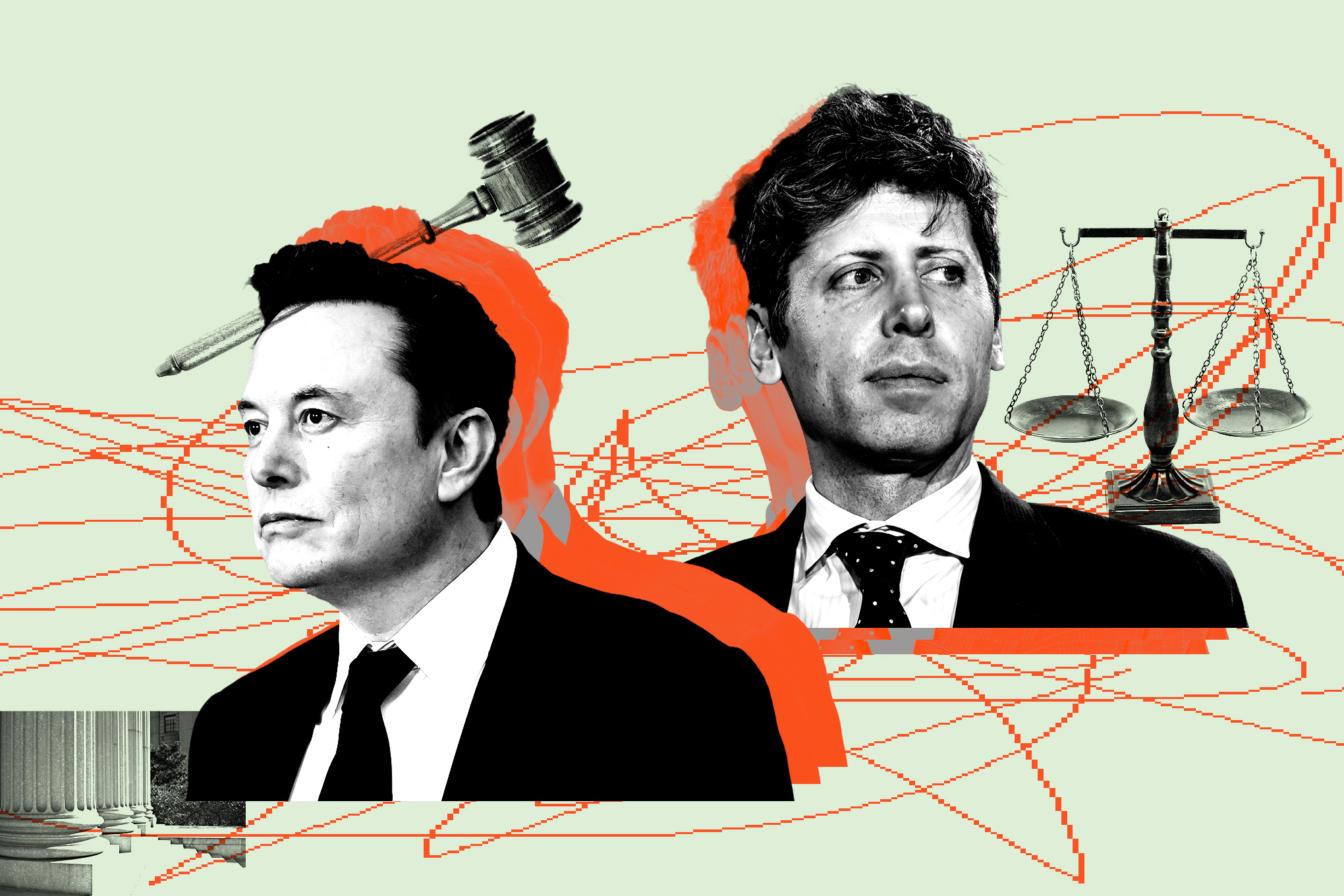
Nine jurors. That’s it. Nine people will soon decide the future of OpenAI, the bleeding edge of AI development. And no, they won’t be pondering existential threats or the singularity. They’ll be sifting through what boils down to a messy breakup, a contractual dispute writ large. Think less Skynet, more small claims court.
This whole circus, with its tales of Elon’s dramatic exit and Sam’s boardroom coup, is theatre. The actual work, the core of what those jurors are agonizing over, is deceptively simple. It’s about whether Musk’s early cash injection came with strings attached. Strings that OpenAI, in its relentless pursuit of commercial dominance, might have snapped.
The Crux of the Case: Broken Promises?
The central question? Did OpenAI and its founders, namely Sam Altman and Greg Brockman, violate a fundamental agreement with Musk? The accusation: his donations were earmarked for a specific, charitable purpose – AI for humanity’s benefit, unchained from corporate greed – not for the general slush fund of a non-profit that was quickly morphing into a profit-driven juggernaut. Then there’s the accusation of unjust enrichment. Did Musk’s money, intended for good, actually line the pockets of the defendants through OpenAI’s burgeoning for-profit arm? And did Microsoft, the tech behemoth now deeply entwined with OpenAI, knowingly facilitate this alleged betrayal? These aren’t abstract AI ethics debates; they are specific legal allegations.
OpenAI, naturally, pushes back. Their defense hinges on a few technicalities. Statute of limitations, they argue. Musk waited too long. Unreasonable delay. He sat on his hands. Unclean hands. Musk himself isn’t exactly an innocent bystander in the AI wars. They also claim no witnesses could recall any explicit restrictions on Musk’s donations. Convenient.
“OpenAI has also made three arguments in its defense that the jury will weigh: Statute of limitations — a legal deadline by which a lawsuit must be filed. Here, if OpenAI can prove that any harms to Musk happened before August 5, 2021 for the first count; August 5, 2022 for the second count; and November 14, 2021 for the first count, then his claims will be moot.”
And here’s the kicker: a forensic accountant testified that all of Musk’s money was spent well before the critical August 2021 date. This is a powerful counterpoint. If the money’s gone, used for its stated purpose, then what’s the beef? It paints a picture of a donation consumed, not exploited.
What a Musk Win Actually Means (Maybe)
If Musk prevails, the ramifications are… nebulous. The headline claim is that it could dismantle OpenAI’s for-profit structure. Imagine that. The company that gave us ChatGPT, the undisputed leader in generative AI, suddenly forced back into a purely non-profit model. But what does that look like in practice? The judge is set to hash out the consequences in new hearings. It’s a legal minefield, and a jury verdict might just render all that debate moot.
Musk’s camp paints a picture of a company that veered sharply off course, especially after the hefty $10 billion Microsoft infusion in 2023. This, they argue, solidified OpenAI’s commercial ambitions, benefiting investors at the expense of Musk’s vision for AI safety. They contend previous investments were different, and this one, made after the statute of limitations supposedly kicked in, was the catalyst for Musk’s legal action. It’s a narrative of betrayal, of a noble ideal corrupted by corporate interests.
OpenAI’s defense, however, attacks the very premise. They’ve paraded witnesses, including Musk’s former confidantes, who can’t recall any specific restrictions on his donations. They argue that private funding was always understood as necessary for OpenAI’s ambitious goals. And let’s not forget Musk’s own attempts to launch a for-profit AI venture and his desire to merge OpenAI into Tesla. This isn’t just about a violated trust; it’s about whether Musk himself played by the rules he now claims others broke.
The Unjust Enrichment Angle: Money Talks
The plaintiffs, Musk’s team, point to the eye-watering valuations of stakes held by figures like Brockman and Sutskever, not to mention Microsoft’s own investment. This, they say, is concrete proof that Musk’s donations ultimately served personal gain, not the charitable mission. They argue that the for-profit entity was hyper-focused on commercial products while the foundation languished, devoid of staff and control. It’s a stark contrast: a dormant charity overshadowed by a booming commercial enterprise. This isn’t what Musk signed up for, they insist.
OpenAI’s counter-argument is equally insistent. All of Musk’s contributions, they maintain, were absorbed by the foundation by 2020, long before he departed in 2018. Any equity distributions came much later. Crucially, they highlight the early consensus among key players: compensating researchers with stock was essential for developing Artificial General Intelligence (AGI). They firmly believe the for-profit’s commercial endeavors directly propelled the foundation’s mission, including its safety objectives. Providing ChatGPT for free, Sam Altman argued, directly serves the mission of democratizing AI’s benefits. It’s a delicate balance: pursuing profit to fund altruism.
What Happens Next (If Anything)
This isn’t just about Musk versus OpenAI. It’s about the delicate dance between profit and purpose in the AI race. If the jury sides with Musk, it forces a reckoning. Will OpenAI revert to its non-profit roots? Or will this trigger a corporate reshuffling of unprecedented scale? We’re watching a legal skirmish that could redefine the very structure of the leading AI labs. It’s a stark reminder that even as we build machines that can write poetry and diagnose diseases, the oldest human dramas – trust, promises, and greed – still hold sway.
🧬 Related Insights
- Read more: Internet Shutdowns Hit Record Highs in 2025 [Global Analysis]
- Read more: Higbee’s Copyright Extortion Fizzles: A Web Host’s Epic Smackdown
Frequently Asked Questions
Will this lawsuit change how AI companies are structured?
Potentially. A win for Musk could force OpenAI to abandon its for-profit arm, significantly altering its business model and potentially influencing how other AI labs are structured moving forward.
Did Elon Musk’s donations really go to OpenAI’s for-profit arm?
Musk’s team alleges they did, contributing to unjust enrichment. OpenAI contends all donations were used by the non-profit foundation before key dates and that equity distributions occurred later. The jury will weigh this evidence.
Is OpenAI still a non-profit?
OpenAI operates with a capped-profit structure. It has a non-profit parent organization, but its primary development and commercial activities are conducted through a for-profit subsidiary, which has attracted significant investment.