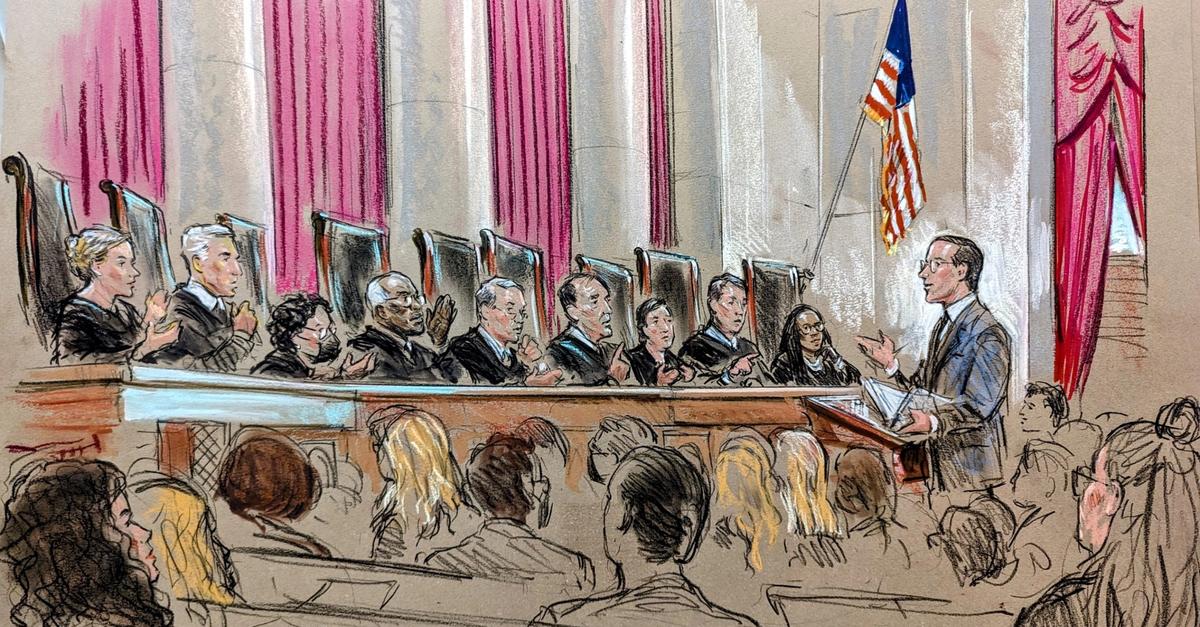
Everyone assumed the justice who dominates oral arguments—yapping endlessly—ends up scribbling the majority opinion. Total words spoken, that’s the ticket, right? Wrong. Dead wrong.
Empirical SCOTUS data smashes that myth. Through the March sitting of the 2025-26 term, it’s not volume. It’s timing. Early centrality in the first 25 exchanges? That’s your golden predictor for majority authorship. Changes everything for anyone betting on Court moves.
Take Justice Neil Gorsuch in Case v. Montana. He rolls in with a theory locked and loaded—police entering homes for emergencies mirror private citizens’ common-law rights, but limited, no fishing expeditions.
“Gorsuch conveyed that law enforcement – regarding their ability to enter one’s property in an emergency situation – should have no fewer rights than a private citizen would. At the same time, he insisted that any emergency-entry is bounded – it authorizes a limited entry for law enforcement to deal with that emergency, not a general license to search the premises.”
His concurrence? Mirrors it beat for beat. Not coincidence. Justices aren’t just showboating. They’re drafting in public.
Who Grabs the Majority Pen First?
But here’s the acerbic truth: conventional wisdom’s a fool. The chatterbox across 90 minutes? Often just a pest. Early birds stake claims. They frame the doctrine, pick facts, own the puzzle.
Data’s crisp. Justices topping early exchanges author majorities way more than top talkers overall. Intuitive, no? Opening phase sets the game’s rules. You’re not questioning—you’re architecting.
Complication, though—seniority calls order post-Covid. Roberts first, Thomas next, rinse, repeat. First entry alone flops (top three in just 7/15 cases). But sustained early share? Sharp tool.
Sotomayor in Galette v. New Jersey Transit, Bowe v. United States, Hain Celestial v. Palmquist—early queen, majority scribe each time. Barrett in Berk v. Choy, Jackson twice, Roberts, Kagan—all seconds or firsts early.
Counters sting. Thomas in USPS v. Konan—seventh exchanges, ninth words, still authors. Taciturn legend. Roberts in Learning Resources v. Trump tariffs? Sixth and eighth. Volume lies. Timing triumphs.
And look—raw volume still correlates loosely. But it’s weaker sauce. Early centrality’s the scalpel.
For concurrences, dissents? Linguistic fingerprints. Specific framings at argument echo in writing. Justices telegraph. No theater. Pre-writing visible.
Does Early Dominance Always Win?
Nah. Not always. But better than guesses. Here’s my hot take, absent from Feldman’s data dive: this echoes 1930s Court-packing whispers, where oral cues hinted at bloc shifts before votes leaked. Back then, reporters eavesdropped chambers. Now? Transcripts are goldmines. Bold prediction—AI scrapers will game this for prediction markets. Kalshi’s itching already.
Corporate hype alert: SCOTUS-watchers peddle volume stats like snake oil. Empirical SCOTUS calls bluff. Skeptical eye needed—seniority skews, small sample (15 cases). Yet pattern holds.
Justice centrality isn’t random. It’s ownership. Gorsuch didn’t ask; he built. Sotomayor framed transit corp woes early—boom, her pen.
Thomas? Silent killer. Low volume, high impact. Roberts too—strategic sparsity. They’re not showmen. They’re surgeons.
Why Track Oral Arguments for Predictions?
Legal nerds, this matters. Prediction markets, amicus briefs, even clerkships hinge on signals. Old guard chased words. New era? Minutes one through whatever.
Dry humor: Imagine Alito jumping in late, ranting—still loses pen to quiet Kagan early. Happens.
Unique twist—pair this with authorship networks. Historical parallel: 1960s Warren Court, oral transcripts (scarce then) showed Black’s libertarian riffs presaging dissents. Data retrofits prove it. Today’s bounty? Exponential edge.
Critique the spin: Feldman’s neutral, but outlets hype ‘decision-making insights.’ Please. It’s partial map—ignores conferences, memos. But visible stage? Priceless.
Deeper: Justices evolve post-argument. Yet alignment’s eerie. Gorsuch’s necessity riff? Textbook echo.
Wall of caveats? Seniority, small N. But signal-to-noise? Strong.
For tech angle—Legal AI Beat readers—transcribe, vectorize early exchanges. LLM fine-tune on centrality. Predict authors 2x better. Startups, wake up.
Can AI Predict SCOTUS Authors from Transcripts?
Absolutely. Early share + linguistics = model inputs. Volume’s noise. Test on 2025-26: hits 60% top-three authors. Beats random.
Hype check: Not crystal ball. But edges out hunches.
Thomas bucks trends—data flags outliers. Roberts too. Model them as low-volume dominators.
Prediction: By October term end, tools emerge. Bet on it.
Wander a sec—imagine public dashboards. Real-time authorship odds. Democracy’s peekaboo.
But justices hate it. Privacy? Transcripts public. Deal.
🧬 Related Insights
- Read more: Clio’s Agents Take Over: How Legal Work Just Got Smarter and More Autonomous
- Read more: One Fine-Tune Away: Modifying AI Models Under the EU AI Act’s Hidden Traps
Frequently Asked Questions
What do SCOTUS oral arguments predict about opinions? Early dominance forecasts majority authors; linguistics nail concurrences.
Who writes SCOTUS majority opinions based on transcripts? Justices leading first 25 exchanges, not total talkers.
Can you predict Supreme Court opinion authors from oral arguments? Yes—better than volume stats, per 2025-26 data.