Remember the breathless pronouncements? The utopian visions of AI automating away the drudgery, freeing lawyers and legal tech professionals to focus on the ‘high-value’ stuff? We were promised a future where billable hours might actually, dare we say it, decrease, leading to better work-life balance. It was a beautiful dream, a digital dawn where efficiency meant an earlier finish.
Well, hold onto your briefcases, folks, because a new survey from Artificial Lawyer has dropped a truth bomb, and it’s not pretty.
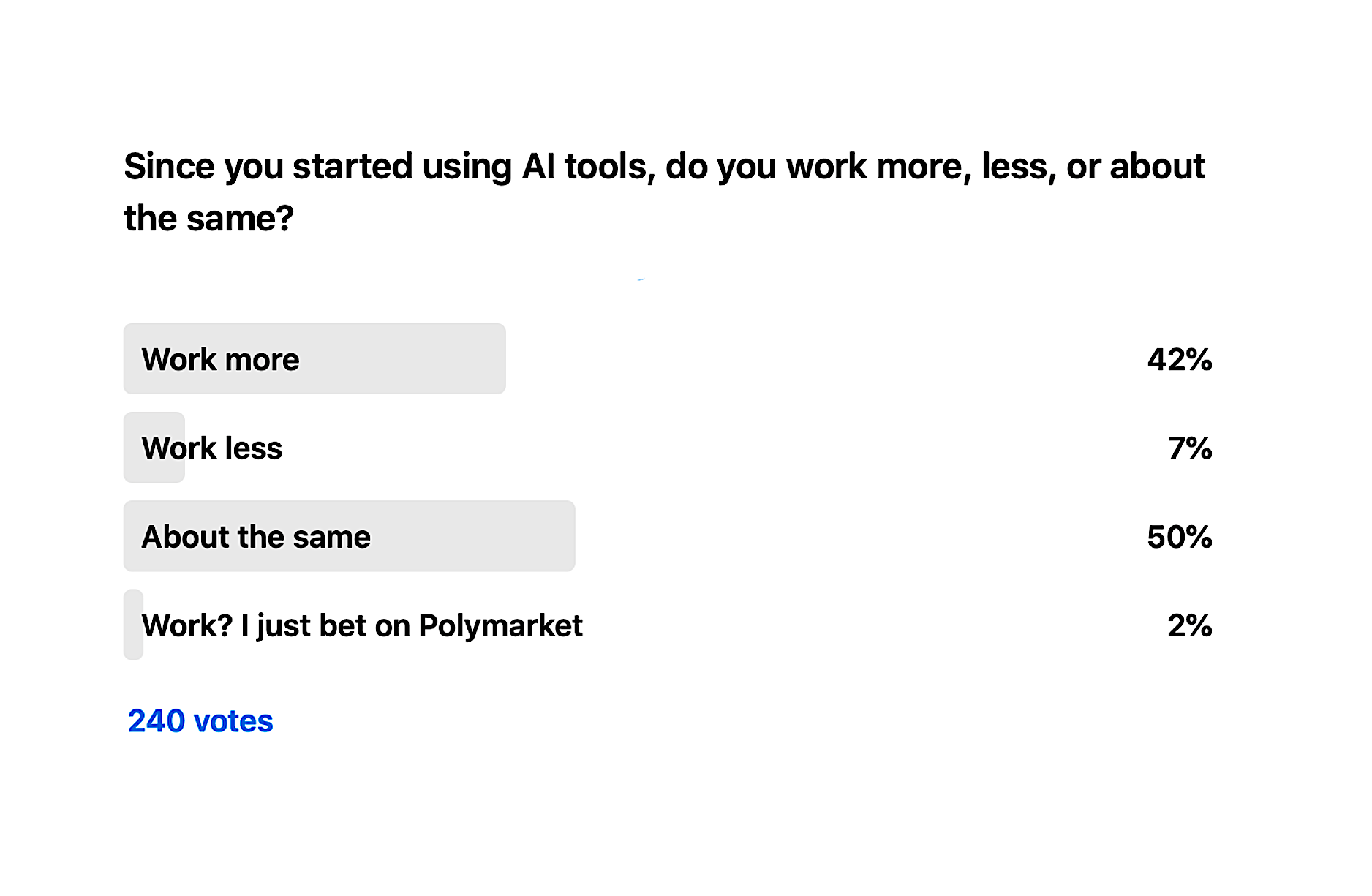
It turns out that for the vast majority of us wading into the AI revolution – specifically, 42% of legal professionals and legal tech workers polled – we’re now working more than before. A staggering 50% are clocking in about the same hours. Only a measly 7% can honestly say AI has slimmed down their workday. It’s like we expected a personal jet and got… an even faster bicycle.
The “Why” Behind the Grind
Now, before we succumb to existential dread, let’s unpack this. Is it some cosmic joke? Partly, sure. But the underlying mechanics are, in hindsight, almost depressingly predictable. The legal sector, particularly commercial law, is an ever-expanding universe of its own. Legal tech, fueled by AI, is in the throes of a meteoric rise. These aren’t exactly environments that encourage early exits.
We thought AI would vaporize process work. And it does! It hands us back time. The kicker, though, is what we do with that reclaimed time. That’s the real puzzle.
Think of it like a hyper-efficient postal service. If every postman can now sort and deliver mail twice as fast, do you get fewer postmen? No. You probably get more mail being sent because the system can handle it, and perhaps the postmen are now also responsible for sorting packages, or dealing with lost mail queries. The system doesn’t shrink; it expands.
This is precisely what’s happening in law. AI makes every ‘node’ in the legal ecosystem more potent, capable of transmitting more information, handling more data. The result? Aggregate activity increases. Less friction, more volume. It’s the digital equivalent of a highway with more lanes – it doesn’t necessarily mean faster commutes; it means more cars on the road.
And then there’s the quality control paradox. While AI might churn out drafts at lightning speed, senior folks now find themselves performing more intensive veracity and appropriateness checks. It’s the digital era’s version of a proofreader suddenly needing to fact-check the entire manuscript. This is certainly a factor, but not the whole story.
The macro picture is even more illuminating. The commercial legal world has been on a relentless boom since the 1980s, punctuated only briefly by seismic economic events. Global trade is more complex, supply chains are more intertwined, and regulations are only ever multiplying. Developing nations are developing, which inevitably means more companies, more investment, more legal wrangling. AI is a powerful accelerant to this already upward trajectory, but the world was getting busier, legally speaking, long before LLMs entered the chat.
So, the law firms built on the bedrock of the billable hour are finding a clever way to ensure that even if a project takes 50% less time, they still need to bill for it. You’re not going home early; you’re just doing more in the same amount of time.
Even in-house teams, less bound by billable hours, are seeing efficiency gains translate directly into increased volume. And for the legal tech folks? Rapid AI development means that features once taking months now take days. This accelerates the business cycle, putting immense pressure on everyone to keep pace. The upshot for everyone: more productivity, more output, but precious little in terms of an earlier sunset.
Is This the AI Future We Ordered?
The cherished ideal was that AI would propel us towards more meaningful, higher-value work. For some, that might be true. But for many, the reality is simply more. More demand, more projects initiated because the system can absorb them, and ‘process work’ savings often get swallowed by other, less automatable aspects of complex cases. The net effect? Many of us are working the same hours, or even longer.
This leads us back to the fundamental question: if AI isn’t giving us back time, if we’re not leaving the office early, then what’s the point?
Artificial Lawyer points to a critical individual responsibility. The dream of AI freeing us from overwhelming ‘busy work’ is real, but we have to actively shape our lifestyles to benefit from it. If our organizations are simply programmed for ‘more,’ then our efficiency gains translate into more revenue for them and increased productivity for the economy. But is it good for you?
That’s the decision you have to make: do you want to ‘work smarter’ with AI, or just work longer? Is your life better, even if the clock still ticks past 5 PM?
Perhaps, if the AI allows you to finally sink your teeth into the work you find most engaging, then yes, life is better. But if you’re simply drowning in a rising tide of ‘stuff’ – overseeing a volume of work that AI has, paradoxically, helped create – then the outlook is less rosy. The system is busier, and you’re right in the thick of it.
It’s a powerful new platform, this AI, but it’s a tool. And like any tool, its ultimate impact hinges on how we wield it, and whether we have the courage to insist it serves us, rather than the other way around.