What if the killer prior art against your patent was filed after yours—but still counts?
Yeah, you read that right. Secret prior art. The dark matter of patent law. Dennis Crouch just crunched the numbers: nearly 25% of office actions now cite this invisible stuff. And it’s not shrinking.
Crouch’s Patently-O piece lays it bare. Applicants scour the world for prior art. Diligently. Obsessively. But these ghosts? Unpublished apps lurking in the USPTO’s vault. They spring out post-publication, retroactively nuking your claims. “Secret springing prior art,” he calls ‘em. Cute name for a nightmare.
Why Does Secret Prior Art Even Exist?
Blame the law. 35 U.S.C. § 102(a)(2). An app’s filing date becomes prior art against later filers—even if unpublished till 18 months later. Supreme Court greenlit this in 1926. Milburn v. Davis-Bournonville. Ancient history, same headache.
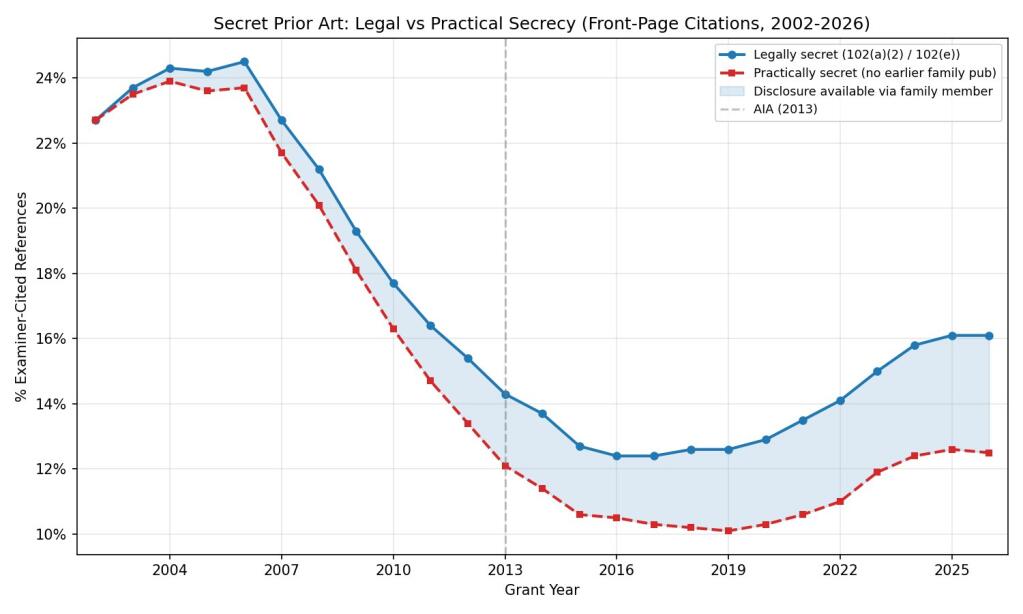
Crouch splits secrets into two camps. Legally secret: Unpublished at your filing date. Practically secret: No family member spilled the beans earlier. Big difference.
“Nearly 30% of office action rejections now cite at least one legally secret reference, up from about 20% a decade ago.”
That’s the scary stat. But dig deeper—practical secrets hover lower. Still, examiners love ‘em. Why hunt when phantoms do the work?
Charts tell the tale. Blue line: legal secrets, dipping post-2001 AIPA publications, then climbing. Red dashed: practical ones, same arc but smaller. Gap? Continuations and PCTs where parents already blabbed. Patent families ballooned. Big Tech’s playground.
And here’s my hot take—the original misses this: it’s straight-up tilting the field to serial filers. Remember the Hilmer doctrine? AIA axed it in 2013. No more blocking your own kids against later siblings. Floodgates opened. Continuations everywhere. Secret art thrives in that mess. Prediction: by 2030, practical secrets hit 20%. Small inventors? Collateral damage.
Is Secret Prior Art Actually Getting Worse?
Hell yes. Three drivers, per Crouch. Global filing boom—more apps, longer unpublished queues. Faster tech fields—AI, biotech—overlap like rush-hour traffic. And that continuation surge.
Post-AIPA dip was real. Publications cut the darkness. But rise since 2015? Inexcusable. USPTO’s bloated. Examiners grab low-hanging fruit. Why cite dusty journals when fresh secrets pop?
Look at the numbers. 233 million citations from 9 million patents. 2002-2026. Solid methodology. Front-page cites only—clean data. But practical secrets? Downright devious. No searcher finds ‘em. Ever.
Crouch’s gap widens yearly. Why? Families. One app publishes, kids stay secret—but identical disclosure. “Effectively available,” examiners shrug. Bull. If it’s not the cited doc, it’s a dodge. PR spin from the Patent Office? They’d call it efficiency. I’d call it lazy.
Short para for emphasis: Big corps win. Always.
The Real Sting for Inventors
You’re filing. Sweat over novelty. Boom—102(a)(2) smackdown. Reference filed Day 90 after you. Published Year 2. How? Secret prior art. No appeal to ignorance. Law doesn’t care.
Fixes? Dream on. Delay publication? Kills the point. Provisional shield? Nah, still vulnerable. IDS disclosures? Band-Aid.
Crouch nods to history. Pre-AIPA wilder. Post? Tamer, then rebound. Global filings explode—China, Europe dumping in. Pipeline clogs. Secrets multiply.
Dry humor time: It’s like cosmic dark matter. We infer it wrecks patents. Can’t see it. Can’t search it. But feel the pull. USPTO astronomers charting the void.
Worse, AIA’s first-inventor-to-file amped stakes. Race harder. File earlier. More secrets ahead. Small fry file defensive. Giants file offensively. Families shield ‘em.
One para wander: Think ENIAC patents tangled in secrets. Or early software. Milburn era same gripe. 100 years later, same crap. Progress?
What Can You Do About Secret Prior Art?
Pray. Or game it. File provisionals early. Swarm with continuations—mirror Big Tech. Costly. Or lobby Congress. Good luck.
Examiners? Train ‘em better. Cite families upfront. Nah. Incentives wrong. Production quotas rule.
Crouch’s data screams reform. Practical vs. legal metric? Mandate it. Stats now? Opaque.
Bold call-out: USPTO spins decline as victory. Ignore the rebound. Hype. Pure hype.
🧬 Related Insights
- Read more: What If ‘Guilty’ Verdicts Upset Criminals? UK’s Wild Satire Exposes Justice’s Soft Underbelly
- Read more: Temple Law Students Draw Line: No ICE Recruiters, No Campus Raids
Frequently Asked Questions
What is secret prior art in US patents?
Unpublished USPTO apps that count as prior art against later filers once published. Filing date backdates ‘em—trapping the unaware.
How common are secret prior art rejections?
Nearly 30% cite legal secrets; practical ones lower but rising. Up from 20% a decade back.
Can you search for secret prior art?
Nope. That’s the point. No public trace till 18 months post-filing.
Will secret prior art kill my patent application?
Maybe. File early, use families, monitor tech spaces. But it’s a crapshoot.