Here’s the thing: for the better part of two years, the legal AI world has been obsessed with the equivalent of AI Turing Tests for paralegals. Could a model ingest a contract and spit out the right clause? Could it summarize a deposition without hallucinating facts? This made for neat, quantifiable metrics, easily showcased in dazzling demos. Everyone expected more of the same, incremental improvements on these micro-tasks.
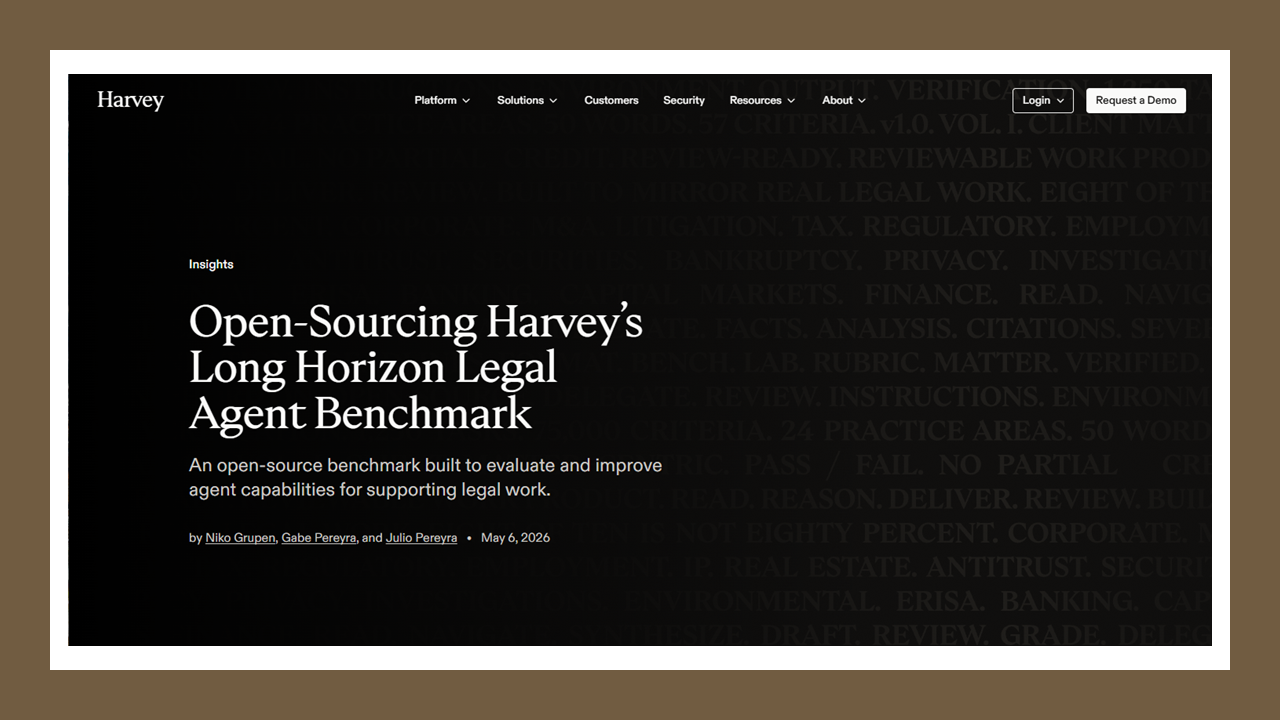
And then Harvey, riding high on its eye-watering $11 billion valuation, drops LAB. The Legal Agent Benchmark. It’s not about spitting out a single answer; it’s about simulating an associate’s entire assignment. Think less ‘summarize this document’ and more ‘draft a memo for the board on this acquisition, considering all these documents, identifying all risks, and proposing next steps.’ It’s a seismic shift, deliberately designed to measure AI agents tackling extended, complex, real-world legal work.
What was the prevailing wisdom? That legal AI’s progress would be measured by its ability to execute granular, discrete tasks with increasing accuracy. Harvey’s new Legal Agent Benchmark (LAB) throws a wrench into that tidy narrative. It’s not about acing a pop quiz; it’s about passing the final exam. This is a stark pivot, moving the goalposts from simple Q&A to simulating actual lawyerly output.
And make no mistake, this isn’t just a few more tasks tacked onto an existing framework. The architecture here is fundamentally different. Harvey’s researchers—Niko Grupen, Gabe Pereyra, and Julio Pereyra—have built LAB around four core elements that mirror an associate’s workflow. First, the instruction itself, framed as a partner’s terse request. Second, a simulated client matter, a closed universe of documents, some relevant, some noise. Third, an output that isn’t just an answer, but actual legal work product. Finally, rigorous verification through expert rubrics that break down the deliverable into atomic, pass/fail criteria. This level of detail — 75,000-plus criteria for over 1,200 tasks across 24 practice areas — suggests a deep architectural rethinking of how AI performance in law should be assessed.
The All-Pass Philosophy: No Room for 80% Right
Harvey’s approach to grading is particularly telling: “all-pass.” A task is only complete if every single rubric criterion is met. No partial credit. The rationale? A deal memo that misses one out of ten material risks isn’t 80% useful; it could be catastrophically useless. This is the kind of hard-nosed practicality that often gets lost in the theoretical haze of AI development. It echoes the stakes in actual legal practice, where a single overlooked detail can derail an entire case or transaction. This insistence on perfection, or at least complete adherence to the defined task, highlights a maturity in their understanding of legal workflows that many other benchmarks have perhaps glossed over.
Why a Leaderboard Isn’t the Point (Yet)
Here’s a critical detail that signals Harvey’s long-term vision: they’re launching LAB without a leaderboard. This is a deliberate move, and frankly, a smart one. They acknowledge that the dataset will evolve, and they want to collaborate with the community to establish clear, intuitive standards for judging performance. This isn’t about a short-term PR victory; it’s about building a foundational tool for the industry. It contrasts sharply with the often-frenzied race for leaderboard dominance seen in other AI domains.
“We’re intentionally launching LAB without a leaderboard because we expect the dataset to evolve over time and we want to work with the community to ensure results are clear and intuitive in how they convey agent performance,” Harvey says.
This consultative approach to benchmarks isn’t unheard of, but in the hyper-competitive legal tech space, it’s a refreshing change of pace. It suggests an understanding that legal AI’s impact isn’t solely about raw computational power, but about its integration into existing, complex human processes.
Is This the Real-World Legal AI We’ve Been Waiting For?
Harvey’s thesis, articulated in their announcement, is that benchmarks have historically served as leading indicators for capability inflection points in various agentic domains. They point to software engineering, where benchmarks tracked the dramatic leap in coding agents’ abilities around December. Now, they position LAB as the analogous “legibility layer” for legal agents. The promise for law firms is straightforward: identify where AI can truly augment teams, and where human oversight remains indispensable.
This moves beyond the abstract. It’s about ROI. It’s about tangible support. It’s about figuring out which associate tasks are genuinely ready for AI delegation, and which require a human in the loop. The legal industry, often criticized for its slow adoption of technology, has spent the last couple of years wading through vendor demos and pilot programs. What it’s lacked is a standardized, reliable way to measure the true capabilities of these AI agents in the context of actual legal practice. Harvey’s LAB aims to fill that void, forcing a more realistic assessment of AI’s utility beyond the flashy demos and incremental improvements.
The implications here are profound. If LAB accurately reflects the demands of real-world legal work, we might finally see a move past the superficial evaluations that have characterized much of legal AI’s public narrative. It’s a call to arms for a more rigorous, pragmatic approach to assessing AI in the profession. It suggests that the next wave of legal AI won’t just be about doing tasks faster, but about doing them more holistically and reliably, mirroring the nuanced judgment that defines excellent lawyering. The question now is whether the rest of the industry will embrace this more demanding standard, or retreat to the comfort of simpler metrics. The early signs suggest a determined push from Harvey towards the former.
🧬 Related Insights
- Read more: From Wachtell to Boutique Glory: Why This Partner Swapped Biglaw for Trial-Ready Teams
- Read more: LexisNexis Reframes Legal AI: Is Protégé More Than Hype?
Frequently Asked Questions
What does Harvey’s LAB benchmark actually test?
LAB tests AI agents on extended, complex legal tasks that mimic real-world associate assignments, rather than simple discrete reasoning tasks.
Will LAB replace human lawyers?
LAB is designed to measure AI agent capabilities to help law firms identify where AI can augment human work, not to replace lawyers entirely.
How can law firms use LAB?
Law firms can use LAB to assess AI performance in specific workflows, inform investment decisions, and determine where AI can best support their teams.