The hum of servers in a San Francisco data center, a monument to relentless innovation, feels eerily quiet when you consider the funding challenges that built it.
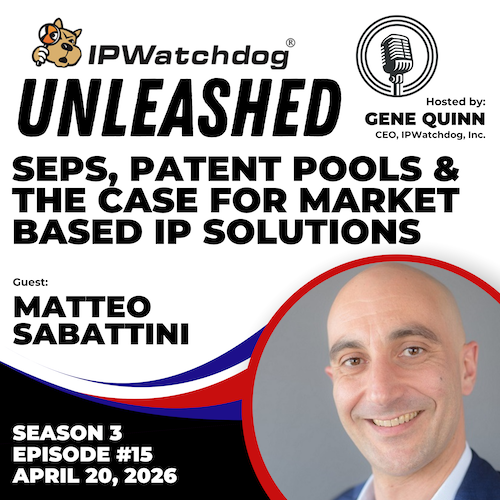
This week, IPWatchdog Unleashed peeled back the curtain on a brewing crisis in the global innovation economy, featuring a conversation with Matteo Sabattini. Sabattini, now back at Sisvel after a stint elsewhere, operates at the nexus of cutting-edge tech, complex licensing frameworks, and the ever-shifting sands of policy. What emerged wasn’t just a critique, but a diagnosis of a system fundamentally out of whack—an imbalance between those who dream up the next big thing and those who simply want to plug it in. The prognosis? Without a serious recalibration, long-term investment in the foundational technologies that underpin our digital lives could wither.
The Numbers Game of Innovation
At the core of Sabattini’s analysis lies a stark reality: the sheer asymmetry between innovators and implementers. For years, patent holders apparently operated under a naive assumption that cooler heads would prevail. That hopeful outlook has been systematically dismantled. Over the past two decades, the implementers—often gargantuan, consumer-facing entities—have mounted a coordinated, relentless advocacy campaign. Innovators, as a collective, have been considerably slower to mobilize. Sabattini validates this diagnosis but injects a crucial nuance. This isn’t merely a failure of proactive engagement; it’s structural.
“There is a numerosity problem,” he stated. “The companies investing in developing new technologies are inevitably outnumbered by companies who actually use these technologies.”
This numerical disadvantage is amplified by a deafening communications gap. Firms that forge foundational technologies—think Ericsson or InterDigital—are rarely household names in the consumer space. They lack the direct pipelines that implementers wield to sculpt public perception and, consequently, steer regulatory priorities. Sabattini framed policy advocacy much like marketing: you notice its absence, but not its quiet, effective presence. The implication is stark. When innovators dial back their engagement—whether due to budget constraints or a strategic misstep—they vacate ground that is swiftly occupied by others, often with different agendas.
Free-Riding: The Unfair Advantage
Our discussion then pivoted to the gritty economics of licensing behavior, where the consequences of this imbalance become distressingly tangible. The prevailing narrative often paints this as a simple clash between rights-holders and reluctant payers. But this framing conveniently sidesteps a critical distortion: the competitive chaos unleashed when some market players dutifully pay for licenses while others simply… don’t. Sabattini offered a disarmingly simple, yet potent, illustration. Imagine a licensing program setting a $1 royalty per unit. If only half the market actually secures a license, the effective rate plummets to $0.50 per unit. This means a substantial portion of the market is effectively free-riding, gaining an unfair competitive edge over those who honor their obligations.
This isn’t some abstract theoretical concern. In sectors built upon standardized technologies—the very fabric of 5G, Wi-Fi, or connected vehicles—participant numbers can be vast, but revenue concentration often skews toward a few dominant giants. When these behemoths delay or outright evade licensing commitments, the onus disproportionately falls upon smaller entities, those ill-equipped for years of protracted litigation. As I noted during our chat, this dynamic is inherently anti-competitive. It’s not merely a squabble over royalties; it’s a blatant distortion of market pricing and the very essence of fair competition. And let’s be honest, it’s probably not just 50% of the market free-riding; in terms of market share and revenue, it’s likely closer to 80% or more.
“Without the availability of injunctions, it is very difficult for any rational player to willingly negotiate a license.”
The Rational Hold-Out and the Litigation Funding Maze
The inevitable destination of this conversation was enforcement. Without genuine consequences for infringement, licensing transforms from a mandatory obligation into an optional add-on. Sabattini was unequivocal: Without the credible threat of injunctions, it becomes exceedingly difficult for any rational market player to willingly enter into a license agreement. In essence, the absence of strong enforcement mechanisms actively incentivizes delay. Companies can use patented technology, postpone payment indefinitely, and force innovators into marathon litigation with outcomes that are anything but certain. The result is a perverse system that rewards defiant hold-out behavior while penalizing those who strive for compliance.
For a long time, I’ve contended that this dynamic reflects a broader erosion in maintaining the integrity of patents as genuine property rights. As I articulated during our discussion, if ownership cannot be meaningfully enforced, it becomes difficult to categorize the asset as “property” in any conventional sense. Sabattini concurred, emphasizing that intellectual property fundamentally lacks the self-enforcing attributes of tangible assets. “You can’t put fences around it,” he observed. Consequently, enforcement isn’t merely an auxiliary function—it must be foundational.
We also waded into the often-maligned waters of litigation funding and patent assertion entities (PAEs), both frequent targets of policy critiques. I clarified that these mechanisms are frequently misunderstood. In many instances, these entities are providing a vital service by enabling smaller innovators, or those with limited resources, to defend their intellectual property against larger infringements. Without them, many valuable innovations might never see the light of day due to the prohibitive cost of legal battles.
Can Patent Pools Be the Market’s Answer?
This is where the concept of patent pools, a market-based solution, enters the fray with renewed significance. Instead of fractured, individual negotiations—a process ripe for hold-outs and protracted disputes—patent pools consolidate rights to essential technologies. Innovators contribute their patents, implementers take a single license covering the entire pool, and royalties are distributed among patent holders based on pre-agreed metrics. It’s essentially a co-op for essential patents.
Sabattini sees these pools as a potential pathway to restoring equilibrium. By aggregating patents for a specific technology standard (like 5G), a pool can offer a more predictable and efficient licensing environment. This can mitigate the “numerosity problem” and reduce the incentive for free-riding. Companies that adopt a new standard can obtain a single, fair license that covers all essential patents, rather than facing a confusing and costly array of individual demands. This standardization of the licensing process itself could be a critical step.
However, even patent pools aren’t a magic bullet. Their effectiveness hinges on fair governance, transparent royalty calculations, and a commitment from all parties to participate in good faith. The historical baggage of antitrust concerns and allegations of anti-competitive behavior must also be carefully navigated. The challenge, as Sabattini implies, is to design and manage these pools in a way that genuinely serves the innovation ecosystem, rather than becoming another arena for strategic maneuvering.
Ultimately, the strain on the innovation economy isn’t a sign of technological fatigue, but a symptom of a licensing and enforcement system struggling to keep pace with the reality of modern R&D. Whether market-based mechanisms like patent pools can truly bridge the gap between those who invent and those who implement remains to be seen, but the conversation has clearly moved beyond hoping for the best to actively seeking solutions.