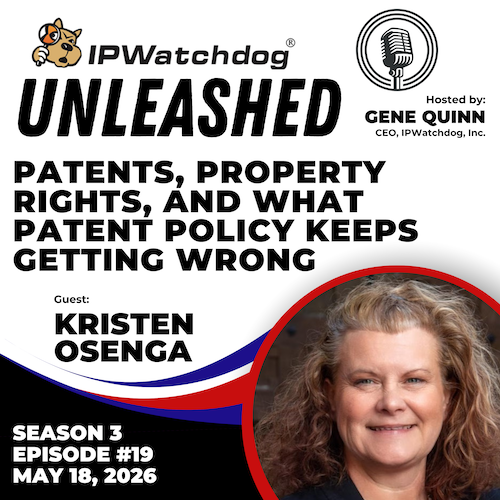
The sterile hum of servers is a far cry from the clatter of a courtroom, but both are arenas where intellectual property gets hammered out. This week, I found myself listening to Kristen Osenga, a law professor and Associate Dean at the University of Richmond, dissect the mess that is modern patent policy. And frankly, it’s a breath of fresh air—or perhaps a stiff gust of reality—in a field often choked by academic jargon and activist agendas.
Osenga, bless her heart, is what you might call a unicorn. She’s pro-property rights, pro-patent, and – get this – pro-innovator. In a world where patents are too often painted as a villain to be shackled rather than a tool to spark ingenuity, her stance is a welcome anomaly. She’s the one asking the inconvenient questions: What are we missing? What are we getting fundamentally wrong? Why do so many patent law debates start with assumptions that are just… not how things actually work?
Her background is telling. She didn’t start out writing dissertations from an ivory tower. Osenga’s journey began in engineering, a hands-on pursuit of building things, like prosthetic legs. After realizing mechanics wasn’t her calling, she pivoted to electrical engineering. It was a conference, of all things – the Society of Women Engineers – that pointed her toward patent law. Law school followed, then practice at Finnegan, a big-deal IP firm, and a stint clerking for a Federal Circuit judge. That practical grounding? It’s gold.
She put it plainly: her time in practice instilled “a real respect for patent owners.” This is precisely the kind of boots-on-the-ground understanding that seems to vanish when policy discussions get handed over to academics who’ve never so much as met an inventor, let alone represented one. The result? Patents are often viewed as a problem to be constrained, not as a fundamental right designed to incentivize risk, disclosure, and investment in the first place.
And it’s not just academics. Judges and policymakers, too, seem increasingly detached from the real-world consequences of their decisions. They might grasp the abstract legal doctrine, sure, but how that doctrine actually plays out in the messy, unpredictable marketplace? That’s often lost. This chasm between theory and practice has been wreaking havoc on patent enforcement for at least fifteen years.
Who’s Actually Suing Whom? The Data Doesn’t Lie (Unlike Some Policy Debates)
Osenga’s current work is trying to bridge that gap, particularly by examining who is actually suing whom in patent litigation. You’d think this would be basic, right? Yet, so much patent policy is built on incomplete or downright skewed assumptions. The dominant narrative, the one that’s been shoved down our throats for years, is the “patent troll” story. Patent trolls are bad; patent trolls sue operating companies; therefore, patent enforcement needs to be restricted. Simple. Effective. And, according to Osenga, a gross oversimplification.
The reality is far more complex. Litigation involves big companies duking it out with other big companies, small entities going after larger ones, universities asserting their patents, startups fighting for survival, and non-practicing entities with business models that are anything but monolithic. Painting them all with the same brush is a recipe for bad policy.
The best definition of a patent troll remains: the patent owner who is suing me. But that cannot be the basis for serious legal reform.
She’s absolutely right. Sure, there’s been abusive litigation behavior – mass demand-letter campaigns, nuisance settlements, attempts to shake down companies over flimsy patents. Those deserve attention. But the policy response has been backward, targeting status rather than conduct. Instead of focusing on bad behavior, the conversation has devolved into suspicion of anyone who doesn’t manufacture products, as if inventing cutting-edge technology is somehow inherently immoral or a poor business choice.
Osenga hammered this point home: what matters is “your litigation behavior, not the fact you make nothing.” This is the crux of it. A university doesn’t manufacture widgets. An individual inventor might not have the infrastructure for mass production. A startup could develop foundational tech but lack the capital, distribution channels, or regulatory know-how. Their product is the invention. Their business model might rely on licensing, and that’s perfectly legitimate. It doesn’t disqualify them from having enforceable rights.
Why Does Patent Policy Keep Missing the Point?
This disconnect isn’t just an academic quirk; it’s a systemic failure that has real-world consequences for innovation. When patent policy is crafted from a place of skepticism towards patent owners, it inherently stifles the very incentives it’s supposed to foster. It tells inventors that their hard-won intellectual property rights might be a liability rather than an asset. This can deter investment, slow down research and development, and ultimately, hurt the pace of technological advancement.
The “patent troll” narrative, while catchy, has done immense damage by creating a false dichotomy. It pits “innovators who make things” against “patent hoarders who sue.” But many entities that don’t directly manufacture are crucial players in the innovation ecosystem. They license their technology to those who do manufacture, enabling commercialization and bringing new products to market. Stripping them of effective patent rights doesn’t protect manufacturers; it removes a vital piece of the innovation engine.
What’s needed is a nuanced approach, one that targets bad actors and bad behavior without undermining the fundamental principles of patent law. It means looking at the substance of patent claims, the reality of licensing negotiations, and the actual impact of litigation, rather than relying on simplistic, often inaccurate, stereotypes.
Ultimately, Osenga’s perspective underscores a simple, yet often ignored