For anyone trying to understand the underlying architecture of technological innovation – how ideas get codified into enforceable rights – the language used in patents is everything. It’s the Rosetta Stone for inventors, lawyers, and even competitors. And lately, that language has been undergoing a profound, almost tectonic, shift. This isn’t just about dry legal jargon; it’s about how abstract concepts like “a thing that does X” get translated into the rigid, formal structure of a patent claim, ultimately defining what is protected and what isn’t.
Twelve years ago, a look at patent filings showed a clear trend: the old-fashioned “means for” language was fading fast, replaced by the seemingly more modern “configured to/for.” But a vital court decision in 2015, Williamson v. Citrix, seems to have injected another layer of complexity, pushing drafters toward a specific type of generic noun followed by a functional phrase – the “nonce” construction. New data, extending this analysis through May 2026, reveals the measurable impact of Williamson, not just on patent drafting trends, but potentially on the very boundaries of intellectual property.
The Erosion of Tradition
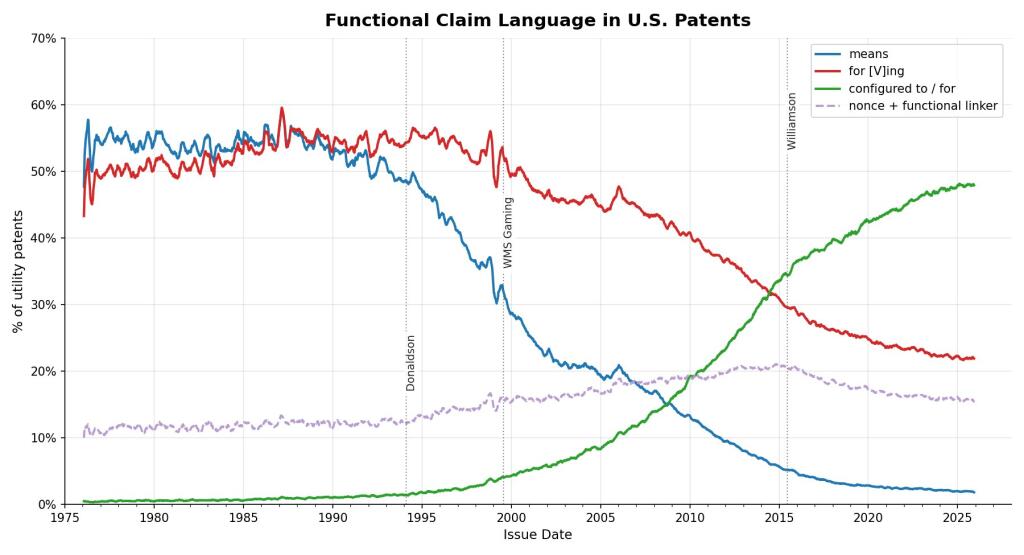
The initial data, tracked from 1976 to 2013, highlighted a dramatic decline in the prevalence of “means for” clauses, a staple of patent drafting for decades. This construction, once nearly ubiquitous, began its steep descent following a 1994 change in patent law. Simultaneously, the older gerund form, like “for transmitting” or “for adjusting,” saw a steady erosion. Their replacement? The seemingly innocuous “configured to/for.” This phrase, by 2014, was already on a steep upward trajectory, becoming the go-to for patent attorneys.
Williamson’s Ripple Effect
The real story, however, picks up with Williamson v. Citrix Online, LLC, the 2015 en banc Federal Circuit decision. This ruling clarified and, in effect, expanded the scope of 35 U.S.C. § 112(f), which deals with means-plus-function claims. Suddenly, generic nouns paired with functional phrases – what the patent community dubs “nonce” constructions (think “module for,” “unit for”) – became areas of intense scrutiny. The court essentially said, if you use these broad terms to describe a function, you might be implicitly invoking the stricter requirements of means-plus-function, requiring you to tie that function to a specific structure in your patent specification.
And the data bears this out. The fourth time series in the new analysis tracks these Williamson-targeted nonce words. From a modest 11% in 1976, they surged to a peak of 20% of utility patents around 2010-2014. But then, something interesting happened. In the decade following Williamson, this trend reversed. The use of these generic nonce terms has now dipped to about 16%.
This isn’t just a minor fluctuation; it’s a direct, measurable response to judicial interpretation. The Federal Circuit signaled that using vague terms like “module” or “unit” to describe a function, without adequately defining the underlying structure, could limit the scope of protection or invite challenges. Drafters, it seems, are heeding the warning, shifting away from the very terms that Williamson brought into sharp focus.
The Shifting Landscape of Protection
So, what does this mean for real people? For inventors and small businesses, it means the landscape of patent protection is more complex than ever. The language used in a patent claim isn’t just descriptive; it’s prescriptive, defining the boundaries of an invention. A subtle shift in wording, like moving from “a module for processing data” to something more specific, can dramatically alter who owns what.
For tech companies, this data underscores the critical importance of patent strategy. The choice of words can make or break a patent’s enforceability. It means that patent attorneys aren’t just legal wordsmiths; they’re architects of technological exclusivity, constantly recalibrating their blueprints based on judicial rulings and evolving trends. The seemingly academic debate about claim language has tangible consequences for market dominance and investment.
The most striking takeaway is how profoundly a single judicial interpretation can reshape established practices across an entire industry. It’s a potent reminder that law isn’t a static code; it’s a dynamic force, constantly interacting with and influencing the very technologies it’s meant to govern.
The data also suggests a bifurcation in how these nonce terms are used. While “unit” and “module” have seen declines since their 2014 peak, terms like “device” continue their upward climb. This implies a nuanced understanding among drafters: certain generic nouns are perceived as more strongly tied to specific structures, and thus less likely to trigger the strictures of § 112(f), while others are more readily flagged as functional placeholders.
The Williamson-targeted ‘nonce’ words rose from roughly 11% of utility patents in 1976 to a peak of 20% in 2010-2014, then turned downward through the post-Williamson decade and now sits at about 16%.
This isn’t just an academic exercise in linguistic trends. This is the granular detail of how intellectual property law adapts. It’s a feedback loop where judicial pronouncements directly influence the language inventors and their counsel use to claim ownership of new ideas. And as technology accelerates, the precision and clarity of these claims become even more paramount.
Questions for the Future
The continued rise of “configured to/for,” now present in nearly half of all utility patents, signals its entrenchment as the dominant functional linker. But the decline in specific nonce terms post-Williamson suggests that while the form of functional claims may persist, their substance is being re-evaluated under judicial microscope.
What this means for the next decade is anyone’s guess, but one thing is clear: the careful construction of patent claims is more important than ever, and the echoes of Williamson will continue to shape how technological innovation is defined and protected.
🧬 Related Insights
- Read more: [USPTO vs EPO] Should US Adopt Problem-Solution for Obviousness?
- Read more: SCOTUS Stays Abortion Pill Ruling, Finalizes Voting Map
Frequently Asked Questions
What does the Williamson v. Citrix decision mean for patent claims?
The Williamson decision clarified that when a patent claim uses a generic noun (like “module” or “unit”) followed by a phrase describing a function, it can be interpreted as a means-plus-function claim under 35 U.S.C. § 112(f). This typically requires the patent specification to disclose a specific structure or material for performing that function, potentially limiting the claim’s scope if not adequately supported.
Will this new data on patent claims affect my AI startup?
Yes, if your startup relies on patent protection for its technology. The language used in your patent claims directly determines what your invention covers. Understanding trends like the decline of certain nonce words post-Williamson can inform your patent drafting strategy, ensuring your claims are strong and enforceable, and don’t inadvertently fall under stricter interpretations of means-plus-function.
Is “configured to/for” still the best way to write patent claims?
“Configured to/for” remains the most common functional linker in patent claims, appearing in nearly 50% of utility patents. However, the Williamson decision has made drafters more cautious about pairing such phrases with overly generic nouns. The optimal approach depends on the specific invention and the desired scope of protection, often requiring a balance between breadth and specificity to avoid unintended legal interpretations.