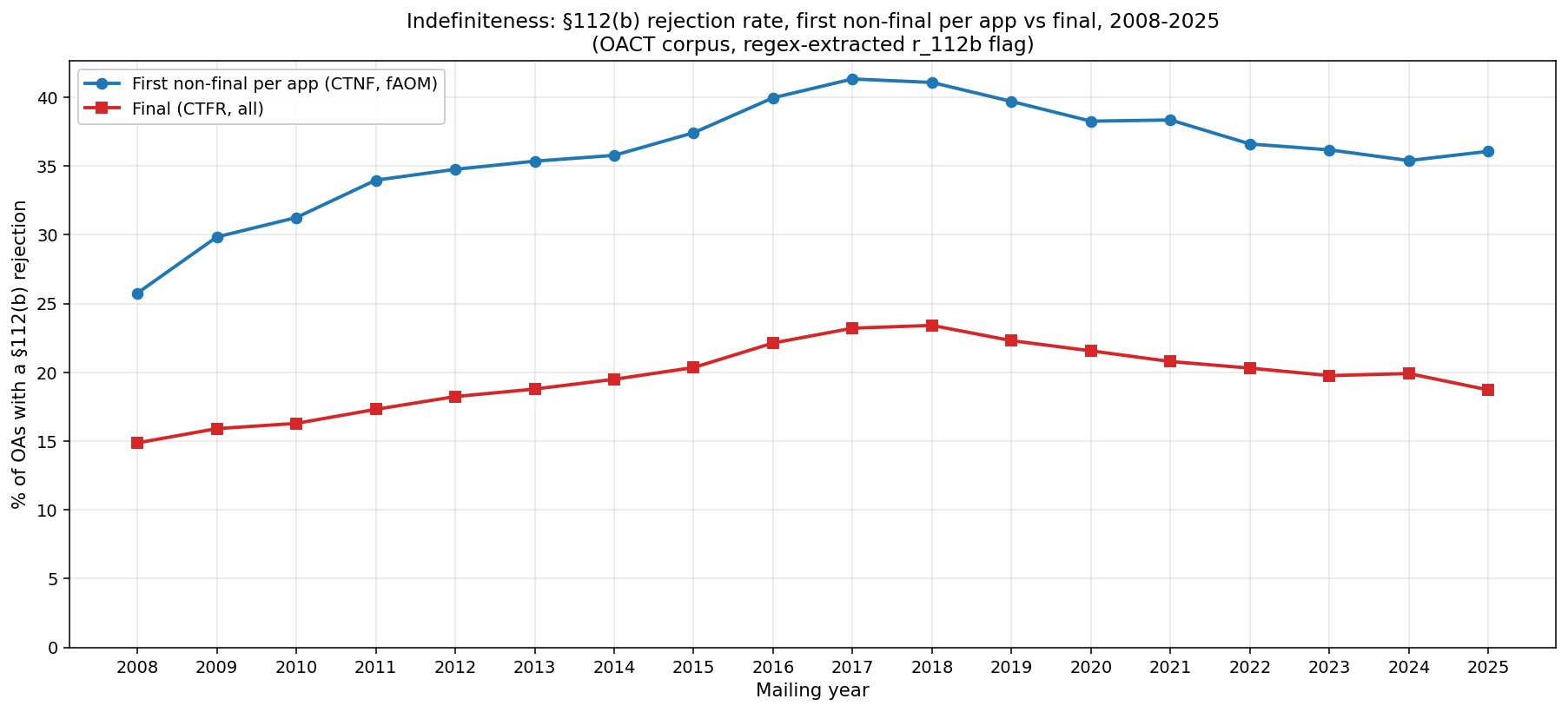
Consider this: 55% of patent applications face a first rejection for indefiniteness under §112(b). That’s a lot of initial hurdles. Now, contrast that with written description and enablement issues under §112(a). Here, only 40% get hit with that first non-final rejection. The numbers don’t lie. They point to a fundamental difference in how these issues manifest during patent prosecution.
What this means is simple. Indefiniteness? That’s usually a drafting slip-up. Something an applicant can tweak, clarify, and move on from. Examiners spot it early, and applicants fix it. It’s a “drafting fixable” defect, as the lingo goes. This aligns with the standard prosecution playbook. First action hits, applicant amends, problem solved. Most of the time, anyway. Of course, sometimes amendments create new headaches. Or an examiner just happens to notice it later. But the general trend holds.
The §112(a) rejections, however, tell a different story. They invert the pattern. Final rejection rates for written description and enablement exceed the first non-final rates. This isn’t about a simple typo. This suggests something deeper is going on.
Why Do §112(a) Rejections Escalate?
It’s about amendments. When applicants try to narrow or shift claims, especially after the initial filing, they often stray too far from the original specification. The disclosure itself hasn’t changed, mind you. It’s fixed from day one. But the claims start to wander, inching into territory the original text can’t possibly support. Enablement and written description problems balloon as prosecution progresses, rather than appearing upfront.
Think about it. Many of these §112(a) issues pop up in continuation cases or international PCT filings where preliminary amendments are common. Applicants are trying to carve out new space, and in doing so, they reveal the gaps. It’s not that the initial application was inherently flawed in its core disclosure, but rather that the evolution of the claims exposed those deficiencies.
The §112(a) inversion reflects a different dynamic. Written description and enablement problems often surface after the applicant amends, particularly when amendments push claim language beyond what the original specification actually supports.
This is where the wheels can really come off for applicants. Indefiniteness, while annoying, is often a manageable bureaucratic hiccup. A scope problem that can be ironed out. But a failure to adequately describe or enable something? That strikes at the very heart of what a patent is supposed to protect. It’s harder to patch up.
Is This Just Bureaucracy, or Something More?
This isn’t merely a statistical curiosity; it’s a window into the patent examination process and, frankly, applicant behavior. The USPTO’s examiners are, by and large, doing their jobs. They’re flagging issues. The question is, are applicants fully understanding the implications of their amendments? Are they treating claim drafting as a rigid science or a fluid art that can lead them astray?
This dichotomy between the two types of §112 rejections highlights a critical point for legal tech developers. Tools that can effectively identify and rectify indefiniteness are valuable. But tools that can predict how amendments might jeopardize written description or enablement? Those are the real game-changers. They require a deeper understanding of the substantive patent law, not just linguistic analysis.
My take? The data confirms what many practitioners suspect: patent prosecution is a tightrope walk. On one side, you have the clear path of fixing scrivener’s errors. On the other, the treacherous climb of amending claims without losing the essence of your invention. The USPTO’s statistics are a stark reminder of which side demands more caution, more foresight, and frankly, better legal counsel.
We’re not just talking about filling out forms here. We’re talking about fundamental rights. And when those rights are jeopardized by amendments that stretch the specification too thin, it’s a signal that perhaps our understanding of claim amendment strategy needs a serious overhaul. This isn’t about AI replacing lawyers; it’s about lawyers needing better tools to avoid these self-inflicted wounds.
🧬 Related Insights
- Read more: Synthetic Data and Privacy Compliance: A Legal Analysis
- Read more: Pam Bondi’s Poll-Topping Peril: Florida Bar’s Ethics Reckoning Looms
Frequently Asked Questions
What is a §112 rejection? A §112 rejection from the USPTO means the patent examiner found issues with the patent application’s claims under Section 112 of U.S. patent law. These relate to indefiniteness (§112(b)) or written description and enablement (§112(a)).
What’s the difference between §112(a) and §112(b) rejections? §112(a) rejections concern whether the patent application adequately describes the invention and teaches others how to make and use it (enablement). §112(b) rejections deal with claims that are unclear or ambiguous.
Can amended claims cause new rejection issues? Yes, absolutely. Amendments, particularly those that broaden or shift the scope of the claims, can inadvertently introduce or highlight problems with written description or enablement that weren’t apparent in the original application.