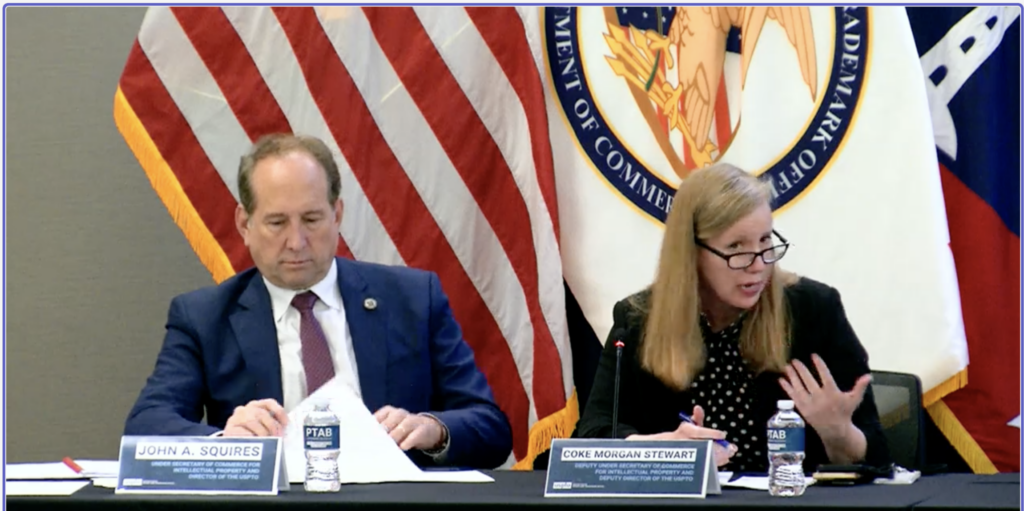
The air in the USPTO conference room felt thick with anticipation, the kind you get when a room full of high-powered legal minds convenes not to argue a case, but to dissect an institution.
That’s precisely the scene at the U.S. Patent and Trademark Office’s third PTAB Listening Session, this time zeroing in on Patent Trial and Appeal Board (PTAB) Administration and Reform. The takeaway? It’s not about revolution, it’s about evolution – and a desperate plea for more consistent, understandable processes.
The Business Imperative: Predictability Over Perfection
Coke Morgan Stewart, USPTO Deputy Director, steered the initial discussion, probing panelists on a fundamental question: should the PTAB’s preponderance of the evidence standard for unpatentability flip to the district courts’ clear and convincing evidence standard? Ben Haber, a partner at O’Melveny & Myers, argued for maintaining the current standard, positing that the PTAB’s technically adept judges don’t need the same safeguards as a lay jury. But the real meat emerged when Ceyda Maisami, Chief IP Counsel at HP, sidestepped the legal minutiae.
Her focus wasn’t on the evidentiary bar itself, but on its downstream effects. “What I want is consistency, transparency, stability, so I’ll be neutral on this one. What serves the business is having that stable, consistent, transparent path that we are able to justify and plan for,” she stated, cutting through the academic debate with hard-nosed business logic. This sentiment echoes across industries; what the business world craves isn’t necessarily a win, but a predictable process that allows for strategic planning and risk assessment.
And then there’s the serial challenge specter. While outright bans on multiple or serial petitions were largely panned as too blunt, the numbers tell a story. Jamie Simpson of C4IP highlighted that General Plastic in 2017 chipped away at the problem, reducing repeat challenges from about 61% to 50%. Still, that leaves nearly half of all petitions as repeats, with 16% being third or later attempts. Stewart’s anecdote of a patent facing seven challenges early on? It’s less a quirky footnote and more a symptom of a system still finding its equilibrium.
Michel’s Clarion Call: Rules, Not Memos
Retired CAFC Chief Judge Paul Michel, a titan in IP law, didn’t mince words. He urged the USPTO to ground its reforms in established case law and, crucially, to codify them through formal rulemaking rather than relying on less durable guidance memos. “I think the examination core needs to have much more intellectual rigor, and by that I mean adherence to the developed case law on validity,” Michel asserted. It’s a call for substance and permanence, a desire to move beyond what can feel like shifting sands.
This isn’t just about legal scholars playing tug-of-war. Adam Mossoff, a professor at George Mason University, pointed out that a lack of clear rules around claim construction and the definition of prior art has created a chilling effect. Businesses, particularly smaller ones and startups, are hesitant to innovate or invest when the intellectual property landscape feels like a minefield.
Corey Salsberg of Novartis emphasized the international implications. A consistent and predictable PTAB process here in the U.S. is vital for global companies trying to navigate a complex patent ecosystem. Inconsistencies at the PTAB can ripple outward, affecting investment decisions and global IP strategy.
The Data Doesn’t Lie: The Need for Systemic Stability
Looking at the raw numbers, the PTAB’s promise as an efficient alternative to costly district court litigation is still a work in progress. While the number of instituted IPRs may have seen a dip recently – Hoffman noting a surprisingly low 15 in April – the underlying concerns about clarity and consistency remain. The Federal Circuit’s consistent denial of mandamus relief in discretionary denial appeals, while establishing a legal precedent, hasn’t erased the practical uncertainty that plagues practitioners.
What’s fascinating here is the underlying tension: the desire for flexibility to address unique patent disputes versus the fundamental business need for a predictable framework. The panelists largely agreed that director discretion in instituting cases is established, but the how and how much remain contentious. Stewart hinted that the USPTO’s proactive guidance is partly a response to lawyers not always surfacing key issues. Yet, as Haber suggests, the statute should dictate discretion, not just settled expectations.
This entire exercise feels like a diagnostic. The PTAB, a decade into its existence, is showing signs of wear, not from overwork, but from a lack of sharp, consistent definition. The market, which is to say patent owners, petitioners, and the businesses that depend on this system, isn’t asking for radical change; they’re asking for a reliable clock, not a sundial. And for an institution tasked with fostering innovation, that’s a fairly basic — and entirely sensible — demand.
🧬 Related Insights
- Read more: Synthetic Data and Privacy Compliance: A Legal Analysis
- Read more: SCOTUS Vacates $47M Verdict Against Texas ISP: Fifth Circuit Gets Wake-Up Call on Contributory Liability
Frequently Asked Questions
What is the PTAB? The Patent Trial and Appeal Board (PTAB) is an administrative tribunal within the U.S. Patent and Trademark Office (USPTO) that hears appeals in patent interference, derivation, and post-grant review proceedings. It also conducts inter partes reviews (IPRs) and post-grant reviews (PGRs) of issued patents.
Why is consistency important for the PTAB? Consistency in PTAB decisions is crucial for businesses and inventors to predict the outcome of patent challenges, make informed investment decisions, and plan their IP strategies with confidence. Inconsistent rulings create uncertainty and can stifle innovation.
Will these proposed PTAB changes affect patent litigation? Yes, changes to PTAB procedures and standards can indirectly affect patent litigation. A more predictable and consistent PTAB may reduce the number of patent cases that proceed to district court litigation, or alter the strategies employed by parties in both forums.