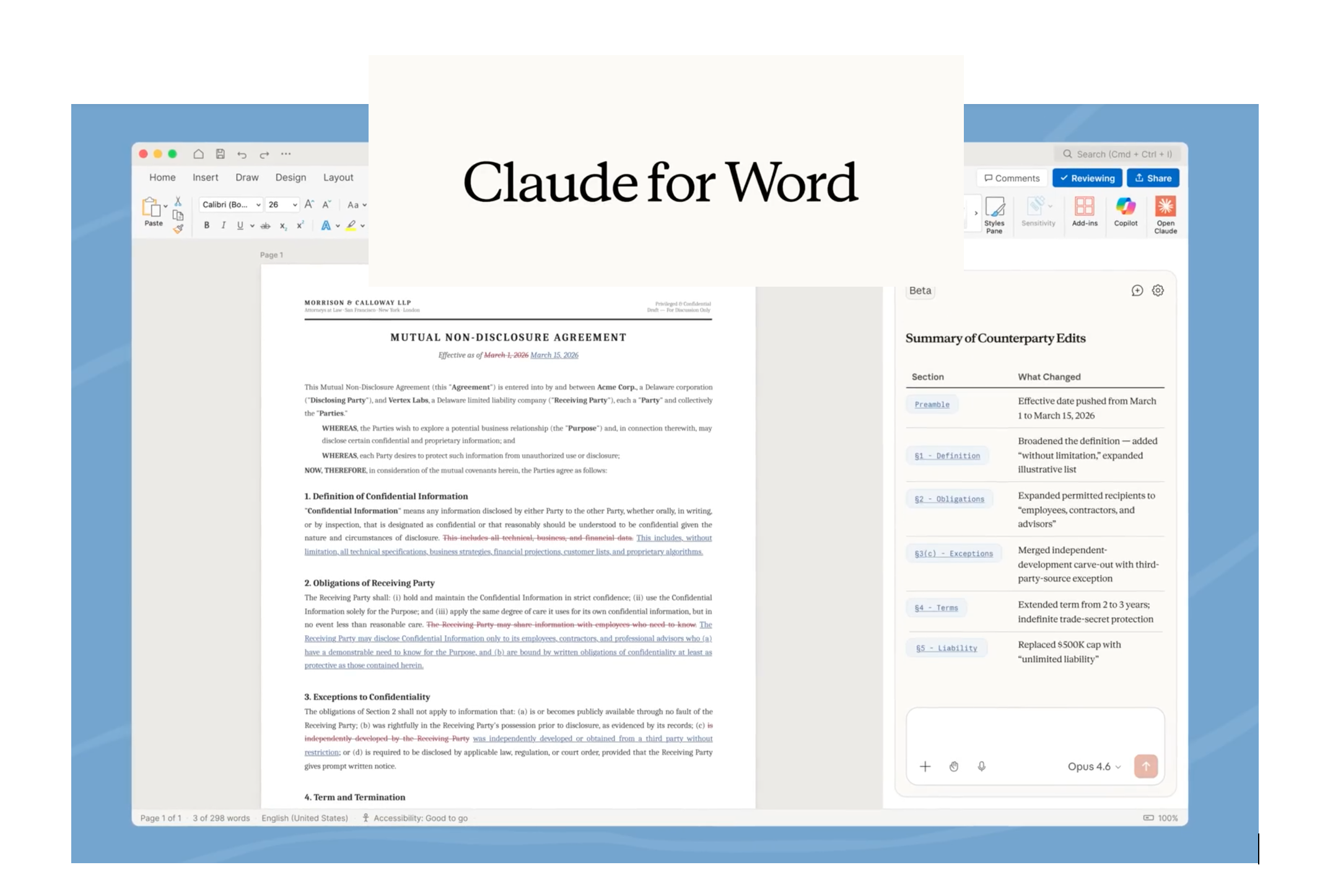
So, what does this whole Ivo vs. Claude for Word showdown actually mean for the folks pouring over dense legal documents? Forget the tech jargon for a second. It means that the promise of slapping a generic AI tool onto your existing word processor to magically fix your contracts might be… a bit premature. For the lawyers and paralegals out there, it suggests that the specialized tools, the ones built from the ground up with legal workflows in mind, still hold a significant edge. And for the execs footing the bill, it means those big bets on off-the-shelf AI might need a second look when it comes to high-stakes legal work.
Here’s the thing: Ivo, a contract intelligence platform, did a “benchmark” – a fancy word for a test – and threw Claude for Word into the ring against their own specialized AI and, get this, a real-life human lawyer. The results? Claude for Word, powered by Anthropic’s Opus 4.6, apparently flunked, scoring a measly 3.5 out of 10. The human attorney landed at 4.56, and Ivo’s own AI nudged ahead at 4.52. So, not exactly a blowout win for the humans, but a solid L for the big, general-purpose LLM.
Is This Even a Big Deal?
Look, none of these scores are exactly setting the world on fire. A 4.5 out of 10 for a human lawyer reviewing contracts? That’s… not great. It hints at a general struggle with the complexity of legal documents, even for those who do this for a living. But then you’ve got Claude at a 3.5. That’s not just ‘could do better,’ that’s ‘needs a serious intervention.’ The report, which was conducted in April 2026 on 19 real, anonymized contracts, found that Ivo outperformed Claude on every single metric, especially in “surgical redlining” and “legal judgment.” Areas where general AI, despite its impressive conversational chops, seems to stumble.
Ivo’s Co-founder and CEO, Min-Kyu Jung, waxed poetic about this, saying:
‘We designed this benchmark to change that by putting real tools against real work, judged by real attorneys. What’s emerging is not a replacement for lawyers, but a new way to scale high-quality legal work, where AI handles repeatable tasks and legal teams can focus on strategy, negotiations, and client outcomes.’
Sure, sure. ‘Not a replacement,’ but a ‘new way to scale.’ It’s the classic tech playbook: promise augmentation, not obsolescence. And who’s making the money here? Ivo, obviously. They’re touting their specialized prowess and, by extension, positioning themselves as the superior choice over the generalists. It’s smart marketing, no doubt, but the core message rings true: legal is a domain with its own deeply ingrained logic and nuances that generic models, at least for now, struggle to grasp.
Why Does This Matter for Real Lawyers?
The big question legal departments are wrestling with, as Ivo pointed out, is “Why can’t we do this with Claude?” or “How are you comparing to Claude’s Word Add-In?” This benchmark offers a pretty stark answer: because specialized legal AI, at least in its current iteration, is built differently. It’s not just about spitting out text; it’s about understanding the implications, the precedents, the potential pitfalls woven into decades of legal practice. Ivo claims their system can digest a stack of contracts in minutes, a task that took the human reviewer about 10 hours. That’s a tangible efficiency gain, and that’s where the real value proposition lies for law firms and in-house counsel.
Think about it: the human lawyer got a score that wasn’t exactly stellar. This suggests that even the ‘gold standard’ has room for improvement. And if a purpose-built AI like Ivo can get that close to human performance, while also drastically reducing turnaround time, that’s a compelling argument. The gap between generic AI and legal AI, according to Ivo, is “miles away” in terms of “legal judgment and contract review.” That’s a bold claim, but the data, as presented, supports it.
The challenge now, for companies like Ivo, is bridging the “gap between AI capabilities and the trust that lawyers have in legal AI outputs.” Lawyers are, rightly, a skeptical bunch. They deal with significant consequences. So, demonstrating not just speed but accuracy and sound judgment is paramount. Ivo’s approach of incorporating lessons from “previously executed contracts and deal context, on top of playbooks” sounds like a move in the right direction – moving beyond rigid rules to something that mimics a lawyer’s contextual understanding.
Who’s Actually Making Money Here?
Let’s cut to the chase. Ivo is making money by selling a specialized solution. They’ve identified a pain point – contract review – and built a tool designed specifically for it. Their benchmark success is a marketing coup, designed to highlight the limitations of broader, more accessible tools like Claude for Word. Anthropic, on the other hand, might not be thrilled with this particular test result. While Claude is a powerful generalist model, its application in highly specific, high-stakes domains like legal contract review, especially without fine-tuning or specialized integrations, might expose its weaknesses.
This isn’t to say general AI is dead in the legal world. Far from it. But it underscores that for tasks requiring deep domain knowledge, nuance, and the potential for significant financial or legal repercussions, specialized tools, developed with that specific industry in mind, are likely to remain dominant. For now, the money is in the deep dives, not the broad strokes, when it comes to legal AI.
🧬 Related Insights
- Read more: Patent Backlog Smashed: AI’s IP Floodgates Open
- Read more: Stick-Figure X Dodges Cigar Giant’s Trademark Bullet: CAFC’s Sharp Turn on DuPont
Frequently Asked Questions
What does Claude for Word do?
Claude for Word is an add-in for Microsoft Word that allows users to use Anthropic’s Claude AI model for tasks like summarizing text, drafting content, and answering questions directly within the word processing application.
How did Ivo perform compared to a human lawyer?
Ivo’s AI scored 4.52 out of 10, very close to the human attorney’s score of 4.56 out of 10, suggesting comparable performance in contract review according to the benchmark.
Will this mean general AI tools won’t be used for legal work anymore?
Unlikely. While this benchmark highlights limitations for complex tasks like contract review, general AI tools can still be valuable for less specialized legal tasks, research, and initial drafting.