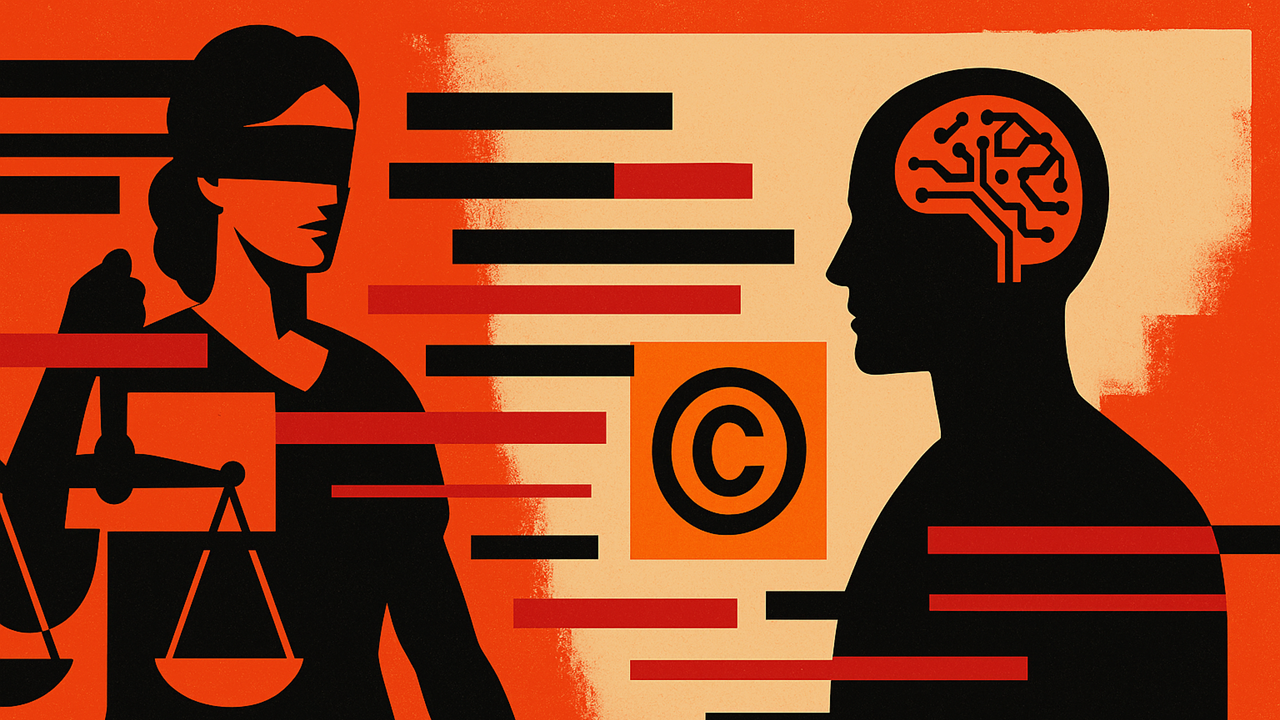
Generative AI tools can now produce novels, compose music, generate photorealistic images, and write functional code in seconds. This explosion of machine-generated creative output has forced a reckoning with one of intellectual property law's most foundational questions: who is the author, and who owns the work?
The answer, as courts and legislatures around the world are discovering, is far from straightforward. Copyright law was built around human creativity, and its application to AI-generated works exposes deep tensions between legal tradition, economic incentives, and technological reality.
The Human Authorship Requirement
Copyright law in most jurisdictions rests on a fundamental premise: protection attaches to original works of authorship created by human beings. This principle, long assumed but rarely tested, has become the central battleground in AI copyright disputes.
The United States Position
The U.S. Copyright Office has taken a clear stance. In its February 2023 guidance on works containing AI-generated material, the Office stated that copyright protection requires human authorship and that works generated entirely by AI without human creative control cannot be registered. The Office examines AI-assisted works on a case-by-case basis, asking whether the human's contributions are sufficiently creative to warrant protection.
This position was reinforced by the Thaler v. Perlmutter decision in August 2023, where a federal court upheld the Copyright Office's refusal to register an artwork created autonomously by the AI system DABUS. The court emphasized that copyright has never protected works generated absent any guiding human hand and that human authorship is a bedrock requirement.
However, the situation grows more nuanced when humans use AI as a tool. If a human provides detailed prompts, selects from outputs, curates, and arranges AI-generated material, some or all of the resulting work may qualify for copyright protection based on the human's creative choices. The Copyright Office has indicated that selection and arrangement of AI-generated elements, much like compilation copyright, may receive protection even when individual AI-generated components do not.
The European Perspective
EU copyright law similarly requires a work to be the author's own intellectual creation, reflecting their personality and involving free and creative choices. The Court of Justice of the European Union has consistently emphasized the personal stamp of the author as essential to copyright protection.
Under this framework, purely AI-generated works likely fall outside copyright protection in the EU. However, European jurisdictions offer somewhat more flexibility in recognizing human contributions to AI-assisted works, particularly where the human exercises creative judgment in directing the AI tool, curating outputs, or integrating AI-generated material into a larger creative vision.
Other Jurisdictions
The United Kingdom stands as a notable outlier. Under Section 9(3) of the Copyright, Designs and Patents Act 1988, the author of a computer-generated work is deemed to be the person who made the arrangements necessary for the creation of the work. This provision, enacted before the current AI era, potentially allows copyright to vest in the person who deploys an AI system, though its application to modern generative AI remains untested in court.
China has seen courts recognize copyright in AI-assisted works where sufficient human intellectual investment is demonstrated. A Beijing court in 2023 held that AI-generated images could receive copyright protection where the human plaintiff demonstrated intellectual investment through prompt engineering, parameter selection, and output curation.
Training Data and Copyright Infringement
A separate but equally contentious question concerns the training data used to build AI models. Most large language models and image generators are trained on vast datasets scraped from the internet, much of which consists of copyrighted material used without permission or compensation.
The Fair Use Debate
In the United States, AI companies have argued that training on copyrighted works constitutes fair use, a doctrine that permits limited use of copyrighted material without authorization for purposes such as criticism, commentary, scholarship, and transformative uses. The argument is that AI training is transformative because the model learns patterns and relationships rather than copying specific works, and the outputs serve different purposes than the training data.
Copyright holders counter that training involves making unauthorized copies of their works, that the outputs compete directly with the originals in the marketplace, and that the scale of copying is unprecedented. Several high-profile lawsuits, including cases brought by the New York Times, visual artists, and authors against major AI companies, are testing these arguments in court.
The EU Approach to Text and Data Mining
The EU's Copyright Directive includes specific provisions on text and data mining. Article 4 permits text and data mining for any purpose where the rightsholder has not expressly reserved their rights through machine-readable means. Article 3 provides a broader exception for text and data mining carried out for scientific research purposes by research organizations and cultural heritage institutions.
These provisions give AI developers in the EU a legal basis for training that is clearer than the fair use analysis in the United States, though the opt-out mechanism under Article 4 creates practical challenges for both rightsholders and AI companies.
Ownership of AI-Assisted Works
Even where copyright protection is available for AI-assisted works, ownership questions arise. If an employee uses an AI tool to create content in the course of employment, the work-for-hire doctrine may vest ownership in the employer. But what if the AI tool's terms of service claim rights to outputs? What if the same prompt produces identical outputs for different users?
These questions become particularly acute in industries like journalism, advertising, software development, and graphic design, where AI tools are increasingly integrated into professional workflows. Employment agreements, contractor terms, and AI tool licenses must all be carefully reviewed and harmonized to avoid ownership disputes.
Practical Implications
Organizations using AI-generated content should maintain detailed records of human creative input at each stage of the content creation process. When possible, humans should exercise meaningful creative control over AI outputs through selection, arrangement, modification, and integration into larger works. Terms of service for AI tools should be reviewed to understand any claims on output ownership. For commercially valuable content, legal review of copyright status is advisable before relying on AI-generated material as a business asset.
The copyright status of AI-generated content will continue to evolve as courts issue rulings and legislatures respond. What is clear is that the intersection of AI and copyright is not a niche concern but a question that touches every industry where creative content has economic value.