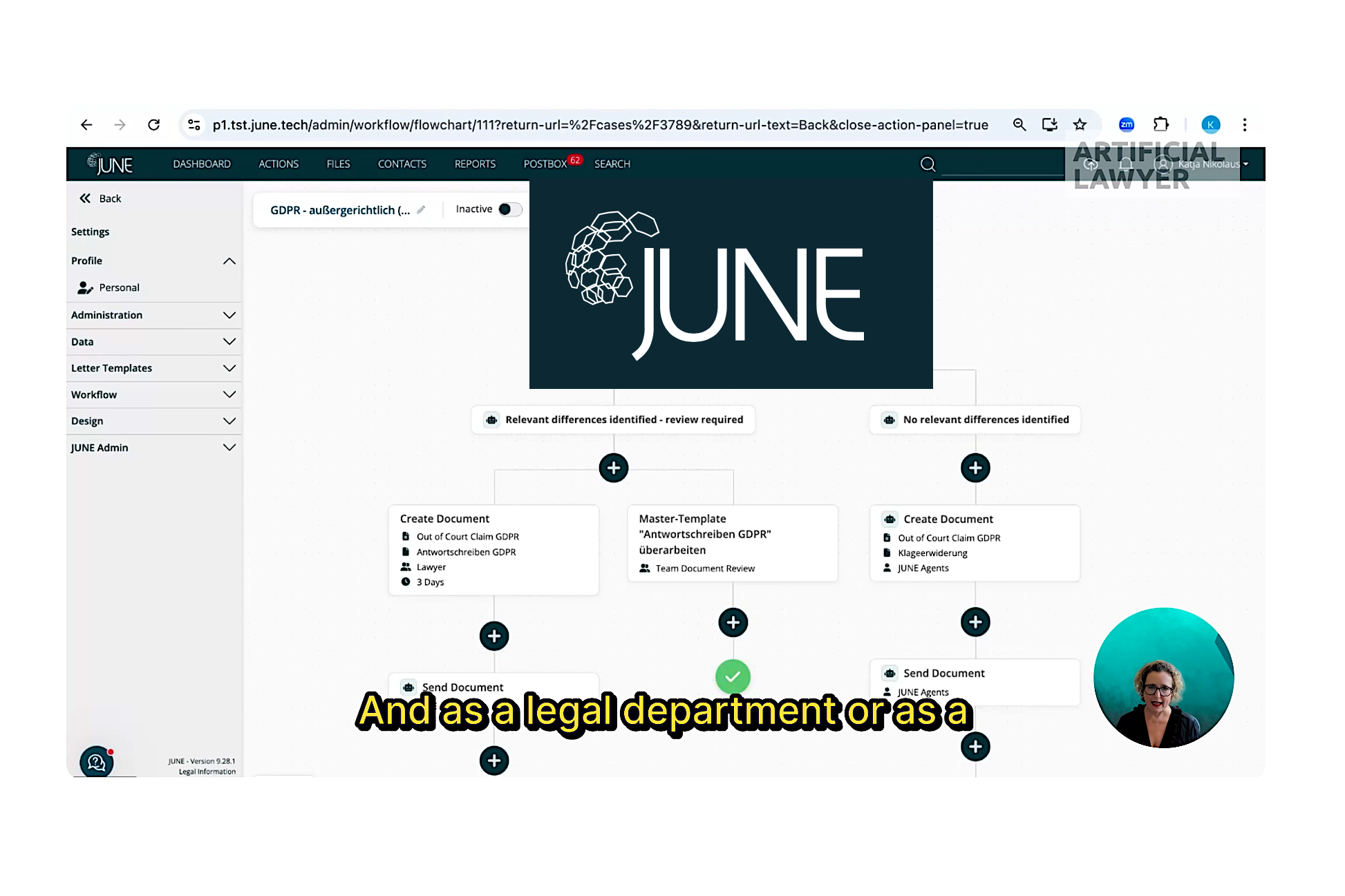
So, an AI walks into a law firm… and starts managing cases. That’s the elevator pitch for June, the latest entrant in the legal automation space, aiming to streamline the often-grueling process of high-volume legal work. This isn’t just about chatbots answering FAQs; it’s about a platform touting the ability to manage the entire case lifecycle, from the initial intake to the final closure, across internal departments and external law firms alike.
June’s core proposition, as laid out in a recent AL TV walkthrough with Chief Business Development Officer Katja Nikolaus, centers on three pillars: a unified platform for case management, autonomous AI agents for crucial operational tasks, and sophisticated batch processing for handling massive datasets of similar cases. Think less ‘digital filing cabinet’ and more ‘digital paralegal on steroids,’ capable of juggling deadlines, routing documents, and even initiating communications without a human necessarily lifting a finger for each individual step.
The EU261 Stress Test: Batch Processing at Scale
This isn’t just theoretical. The demo highlighted a real-world scenario: the EU261 airline passenger rights regulation. This regulation, often involving thousands of similar claims against airlines for flight disruptions, is precisely the kind of high-volume, repetitive legal grind that June purports to conquer. The demonstration showed how the platform can process 500 identical EU261 cases as a single, coordinated unit. This batch processing capability is key – it’s the difference between handling cases one by one and tackling them in efficient, organized waves, dramatically reducing the manual overhead that plagues such operations.
The implications here are significant for legal departments that routinely deal with mass torts, class actions, or any area where similar claims pile up. The ability to treat hundreds, if not thousands, of cases as a singular workflow — allowing AI agents to manage routing, track deadlines, and facilitate communications for the entire batch — could unlock unprecedented levels of efficiency. It’s a direct challenge to traditional models that often rely on armies of junior associates and paralegals to sort through the paperwork. And frankly, if this scales as advertised, it’s a major economic signal for how legal services will be delivered in the coming years.
Autonomous Agents: The Real AI Play?
But the real meat, from a technological standpoint, lies in the AI agents themselves. June claims these agents can autonomously manage routing, deadlines, and communication. This suggests a move beyond simple workflow automation into more intelligent task management. Imagine an AI that not only knows a deadline is approaching but can proactively communicate with opposing counsel, gather necessary documentation based on pre-set criteria, and update all relevant parties without human intervention. This level of autonomy is where the true promise — and peril — of legal AI lies.
There’s a fine line between helpful automation and reckless autonomy. The success of platforms like June will hinge on the accuracy, reliability, and ethical guardrails built into these AI agents. Misrouting a critical document or botching a communication deadline for a single case is one thing; doing it for 500 cases in a batch is another entirely. The legal industry, notoriously risk-averse, will demand rigorous proof of concept, not just polished demos, before fully entrusting sensitive legal matters to unsupervised AI.
The demo covered three areas: the full case lifecycle on a single platform; AI agents managing routing, deadlines, and communication autonomously; and batch processing of large case series, illustrated with an EU261 airline scenario running 500 identical cases as a single coordinated unit.
This unified platform approach is an ambitious play. Many legal tech solutions address specific pain points – e-discovery, contract review, e-filing. June aims for the entire continuum. If it can truly stitch together intake, investigation, negotiation, and closure into a cohesive, AI-supercharged workflow, it’s a significant step forward. However, the complexity of the legal profession, with its myriad nuances, exceptions, and requirement for human judgment, presents a formidable obstacle. Can AI truly master the art of negotiation or the strategic foresight required in complex litigation?
June’s Strategy: A Calculated Gamble?
June’s bet on AI-driven case management for high-volume matters is a calculated one. The market is ripe for solutions that can tackle the sheer volume and repetitive nature of certain legal tasks. The efficiency gains, if realized, could be enormous, freeing up legal professionals to focus on higher-value strategic work rather than administrative drudgery. However, the narrative of AI replacing human lawyers wholesale has been overblown for years. More realistically, June is positioning itself to be a powerful augmentation tool, a force multiplier for legal teams.
The company’s emphasis on autonomous agents, while exciting, also raises questions about oversight and accountability. Who is liable when an AI agent makes a costly error? These are the thorny ethical and regulatory issues that Legal AI Beat covers extensively. For now, June is offering a glimpse into a future where AI doesn’t just assist, but actively manages substantial portions of legal workflows. Whether this future is ready for prime time, or still requires significant human supervision and refinement, remains the crucial question.
What Does June Actually Do?
June is an AI-driven case management platform designed to automate the end-to-end legal process for high-volume legal proceedings. It handles everything from initial case intake to final closure, utilizing AI agents to manage tasks like routing, deadlines, and communications, and offers batch processing for large series of similar cases.
Is June’s AI Genuinely Autonomous?
June claims its AI agents can autonomously manage routing, deadlines, and communication. While the demonstration highlighted this capability with scenarios like EU261 claims, the extent of true, unsupervised autonomy in complex legal scenarios is a key area for ongoing evaluation and will require strong testing and validation.
How Can This Technology Impact Law Firm Workflows?
June’s technology has the potential to dramatically increase efficiency in law firms dealing with high-volume case loads by automating many administrative and procedural tasks. This could allow legal professionals to focus on more strategic aspects of legal work, potentially reducing costs and turnaround times for clients. However, careful integration and oversight will be necessary to ensure accuracy and compliance.