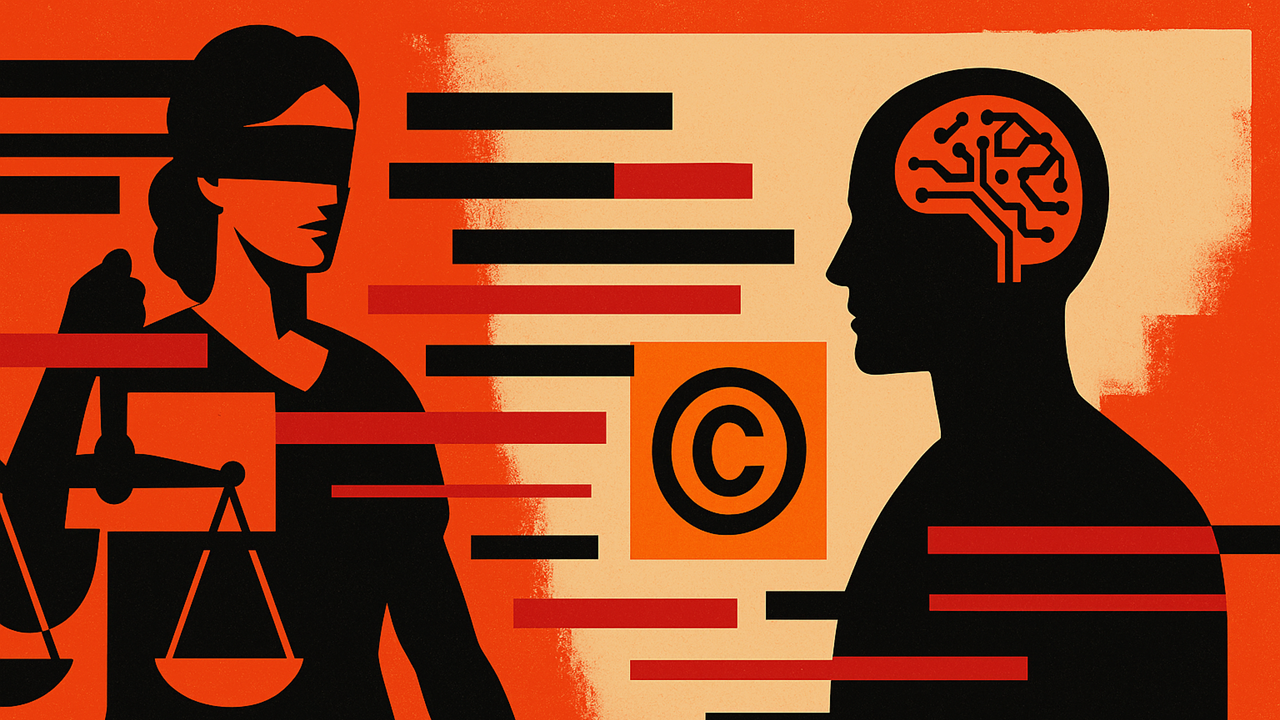
Generative AI systems capable of producing text, images, music, code, and video have disrupted assumptions that have underpinned copyright law for centuries. The legal questions are numerous and interconnected: Can AI-generated outputs be copyrighted? Who owns them? Does training AI on copyrighted works constitute infringement or fair use? How should creators be compensated when their works are used to train AI systems? These questions are being litigated, legislated, and debated simultaneously across multiple jurisdictions, and the answers will reshape the creative economy.
Copyright Protection for AI-Generated Works
The Human Authorship Requirement
Copyright law in most jurisdictions requires human authorship as a prerequisite for protection. In the United States, the Copyright Office has consistently maintained that copyright requires an author who is a natural person. This position was reinforced in the Thaler v. Perlmutter decision, where the court upheld the Copyright Office's refusal to register a visual artwork generated entirely by an AI system without human creative involvement.
The Copyright Office has provided additional guidance through its registration guidance for works containing AI-generated material, published in February 2023 and subsequently updated. The guidance establishes that works created entirely by AI without human creative control are not copyrightable, but works that combine AI-generated elements with sufficient human creative expression may be eligible for protection. The copyright would extend only to the human-authored elements, not the AI-generated components.
The Spectrum of Human Involvement
The practical challenge lies in determining what constitutes sufficient human creative expression when AI tools are involved. The Copyright Office has identified a spectrum of involvement. At one end, a person who merely types a simple prompt and accepts the raw output has not exercised sufficient creative control. At the other end, a person who uses AI as a tool while making numerous creative decisions about selection, arrangement, and modification of the output may qualify as an author.
Relevant factors include the degree of creative control exercised through prompt engineering, the extent of human selection and curation of AI outputs, modifications and refinements made by the human creator, and the overall creative arrangement of AI-generated and human-created elements. This framework creates significant uncertainty for creators, as the line between sufficient and insufficient human involvement is drawn on a case-by-case basis.
Training on Copyrighted Works
Perhaps the most commercially significant copyright question involves whether training generative AI systems on copyrighted works constitutes infringement. The answer depends on the jurisdiction and the specific facts of each case.
Fair Use in the United States
In the United States, defendants in AI training lawsuits have invoked the fair use doctrine, arguing that training constitutes a transformative use because the purpose is to learn statistical patterns rather than to copy or reproduce specific works. The fair use analysis considers four statutory factors: the purpose and character of the use, the nature of the copyrighted work, the amount and substantiality used, and the effect on the market for the original.
The transformative use argument has some support in precedent. In Google LLC v. Oracle America, Inc., the Supreme Court found that Google's copying of Java API declarations for use in the Android platform was fair use, emphasizing the transformative purpose of enabling a new platform. AI developers argue that training similarly serves a transformative purpose of creating a new technological capability rather than substituting for the original works.
However, several factors complicate this argument. Generative AI systems can produce outputs that are substantially similar to training data, creating potential market substitution. The scale of copying involved in training, often encompassing millions or billions of copyrighted works, is unprecedented. And the commercial nature of most AI development weighs against fair use.
Major Litigation
Several landmark cases are testing these questions in US courts. The New York Times v. Microsoft and OpenAI lawsuit alleges that GPT models were trained on millions of Times articles and can reproduce them with substantial similarity. The Andersen v. Stability AI case brings similar claims on behalf of visual artists against image generation models. The Authors Guild v. OpenAI case represents thousands of authors asserting infringement claims related to book-length works used in training.
These cases are proceeding through the courts as of early 2026, with no definitive rulings on the core fair use questions. The outcomes will have enormous implications for the AI industry and creative economy.
European Approach: Text and Data Mining Exceptions
The European Union takes a different approach through the text and data mining (TDM) exceptions in the Digital Single Market Directive. Article 3 provides a broad exception for text and data mining for scientific research by research organizations and cultural heritage institutions. Article 4 provides a more limited exception for other purposes, but crucially allows rightholders to opt out by reserving their rights in a machine-readable format.
This opt-out mechanism creates a fundamentally different dynamic than the US fair use framework. Rightholders who do not want their works used for AI training can expressly prohibit it, and AI developers must respect those reservations. The practical effectiveness of this system depends on the implementation of machine-readable opt-out mechanisms and the willingness of AI developers to comply with them.
Implementation Challenges
Several challenges affect the EU approach. The definition of what constitutes an effective machine-readable reservation is still being clarified. The robots.txt protocol has been proposed as one mechanism, but it was not designed for copyright management and has limitations in this role. The relationship between the TDM exceptions and the AI Act's transparency requirements regarding training data is still being worked out by regulators.
Emerging Legislative Approaches
Several jurisdictions are developing new legislative frameworks to address AI and copyright. Japan has historically maintained a broad exception for computational analysis of copyrighted works, though recent debates have led to calls for limitations on this exception when outputs compete with original works. The UK considered but ultimately did not adopt a broad TDM exception for commercial purposes, leaving the law in a state of uncertainty.
In the United States, Congress has held hearings on AI and copyright but has not enacted legislation. Several bills have been introduced, including proposals for mandatory disclosure of training data, compensation mechanisms for creators whose works are used in training, and limitations on the scope of fair use in the AI context. Whether any of these proposals will advance remains uncertain.
Licensing and Compensation Models
In the absence of clear legal rules, market-based solutions are emerging. Several AI companies have entered into licensing agreements with content publishers, news organizations, and stock media providers. These agreements typically involve upfront payments, ongoing royalties, or revenue-sharing arrangements in exchange for authorized access to copyrighted content for training purposes.
Collective licensing models are also being explored. Organizations representing authors, musicians, and visual artists are developing frameworks for collective negotiation with AI developers, similar to existing collective licensing arrangements in the music and broadcasting industries. These models could provide a scalable mechanism for compensating creators while enabling AI development, but they require agreement on valuation, distribution, and governance structures that are still being negotiated.
Practical Guidance for Organizations
Organizations developing or deploying generative AI should carefully assess their copyright exposure across both training and output dimensions. For training, this means documenting the provenance of training data, respecting opt-out mechanisms where applicable, considering licensing arrangements for high-value content, and monitoring litigation developments that could affect the legality of current practices.
For outputs, organizations should implement content filtering to prevent the generation of outputs that are substantially similar to known copyrighted works. They should educate users about the limitations of copyright protection for AI-generated content and ensure that internal use of AI-generated materials does not create unintended legal exposure. The copyright landscape for generative AI remains deeply unsettled, and organizations that proactively manage their exposure will be better positioned regardless of how the law ultimately develops.